Dear Reader, Thanks For Writing!

Writers appreciate hearing from their readers.

M. Weidenhoff

Writing can be a lonely business. You spend hours in your head, talking to yourself, hanging out with imaginary people.

You sit at a desk trying to spin chaos into order.

Some days, the jumble of words magically align, like a string of pearls to polish and present.  

But where these words land, who sees them, and how they are received is not always apparent.

That’s why it is so gratifying to hear from a reader–whether in-person, through email, or online comment. (I occasionally get a phone call but only from those I know personally.)

Many of you prefer communicating via the Contact Evelyn page rather than leaving a public comment. Some readers ask for writing advice.

Through my website, I’ve heard from men I once dated and friends from years back. Occasionally, I get a creepy letter or comment. That’s when the BLOCK option comes in handy.

My blog stats range far and near: Israel, India, Denmark, New Zealand, Romania. I hear from kindred spirits across the country. I feel fortunate to have met, in Real Life, two of my blog readers and was enriched by the experience.

My July 2022 post Is It Ever Too Late To Find Love? generated a lot of mail. (Including one marriage proposal!) You had lots to say on this topic and wanted to share your tales of both woe and joy in love.

Loui Juver

Because I write frequently about grief, I receive letters from readers sharing their personal loss. These are the hardest letters to read, but also the ones that most touch my heart.

A distraught woman who had just lost a close family member in a fiery car crash wrote to me a couple months ago. She read an essay I’d recently published in Chicken Soup for the Soul. Her letter was detailed, heartfelt, and, I admit, triggering for me.

Still, I took the time to answer the best I could, knowing that she was in the hardest part of her grief journey.
A.M Zilberman

Ten years ago, I published an essay in Tablet Magazine about feeling ambivalent toward my 20 year old daughter’s impending marriage. This story continues to circulate, probably around wedding season, and I receive emails from mothers and fathers in a similar predicament. Fortunately, I have gained wisdom since then to share, along with a happy ending.

I receive fewer letters about my short fiction, though some readers have questioned whether I was writing about them. Answer: No.

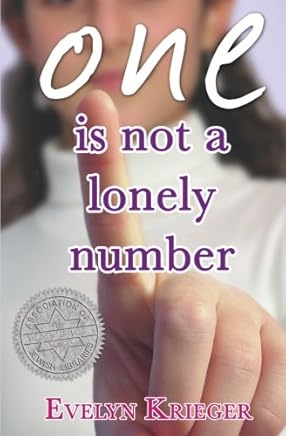
One of the most memorable letters came from a Montana reader of my YA novel, One Is Not A Lonely Number.

“I’m the only Jewish girl in my school. Reading your book made me feel less alone. Getting to know Talia and her friends meant so much to me. I loved the way you showed how they were religious but also regular girls who get into fights and mess up like everyone else...”

Whether a debut or seasoned author, such personal letters often mean more to the writer than a book review or promotional tweet (which, of course, are also appreciated!)

I like to pay the kudos forward.

After reading a book or story that impacted me, I will take a moment to find the author’s contact info and let him/her know. This practice has led to enjoyable correspondence for me as well.

We creative souls write for many reasons: to make sense of the world, understand ourselves, explore obsessions, persuade, provoke, illuminate, entertain, and inspire.

Many of us write to connect with others.

So, thank you dear reader for writing!

Happy Pi Day!

Pi Day
From PiDay.org

Happy Pi Day!

In case you’re scratching your head…Pi Day falls on March 14. It’s as a celebration of the first 3 significant numbers of  the math constant represented by the Greek letter π—3.14

Remember calculating the area of a circle? 

Divide any circle’s circumference by its diameter; the answer (whether for a pie plate or a planet) is always approximately 3.14.

Pi has a rich history beginning in the ancient world.  Some attributed magical meaning to  π.  For a few thousand years, mathematicians have been scratching their heads over its properties.

Pi Day is celebrated around the globe with pie eating, math chats, contests, and related activities.  MIT has been known to send out its admission decisions on March 14. San Francisco’s Exploratorium has an entire exhibit devoted to this mysterious number.

Could you compete in a Pi memorization contest? 

This is a particularly impressive feat as there appears to be no repeating pattern in the constant.   

Kids (and grownups, too) are fascinated by the idea that Pi never ends! In other words, if you write it out as a decimal, you’re going to need a ton paper.

3.1415926535897932384626433…

Maybe your children, or grandchildren, are lucky to have a school celebration today for this irrational number.

When my kids were home, I baked a pie on March 14.  We explored circle art and puzzles. 

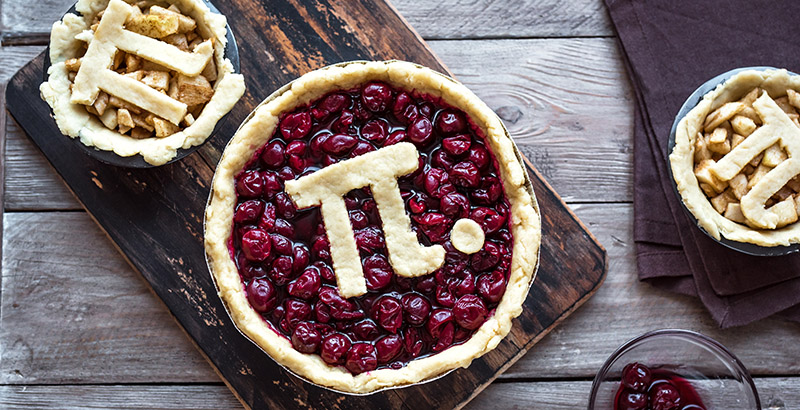
Pi Day Cherry and Apple Pies
From 74million.org

As an educator, I’m passionate about helping kids see math as more than arithmetic.  As a private tutor, I’m often dismayed by the dull and relentless worksheets kids get for math homework.

And don’t get me started on the state of math education.

I advise parents not to leave their child’s math learning to school. Supplement and augment. 

Kids need to develop a strong number sense.  Make math a part of your daily life together: cooking, building, measuring, counting, estimating, banking, graphing, calculating, sorting, scoring, and shopping.

Introduce the language of math to little ones. No need to keep negative numbers a secret until sixth grade.  Hey, it’s minus ten degrees in Boston!   

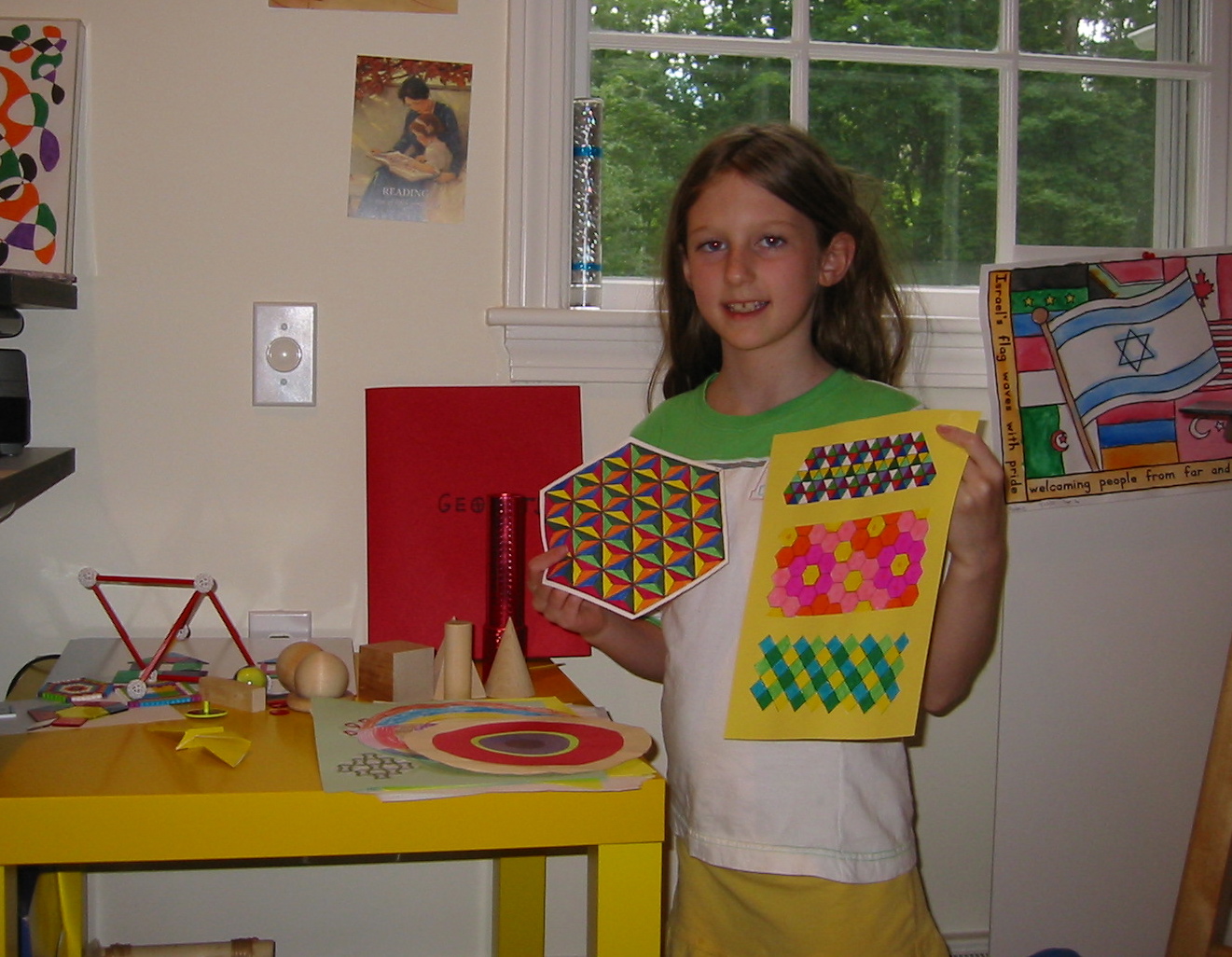
Play with polygons and trapezoids and tessellations.

IMG_7385
Audrey’s Geometric Display.

Read your kids and grandkids fun math-related picture books:

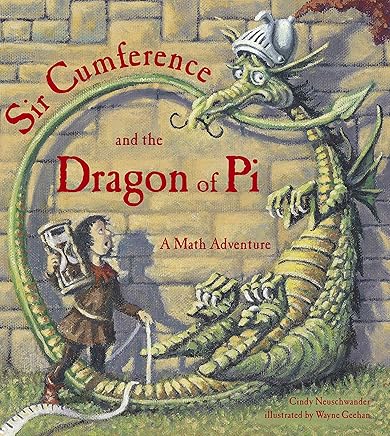
Sir Cumference and the Dragon of Pi by Cindy Neuschwander

Sir Cumference and the Dragon of Pi (A Math Adventure)T

The Grapes of Math by Greg Tang

Circle, Square, Moose by Kelly Bingham.

Count the Monkeys by Mack Barnett

Counting on Katherine: How Katherine Johnson Saved Apollo 13 by Helaine Becker

My favorite, for older readers–The Number Devil by Hans Magnus Enzensburger

In my middle-grade novel, One Is Not A Lonely Number, Talia, the 13-year-old narrator, is a math whiz who sees numbers in color with distinct personalities. While the story is about friendship, family, and faith, math plays an important role. I wanted to offer young readers a good story while presenting a girl’s love of numbers in a unique way. Kids write to me saying they enjoyed this aspect of the book.

. One Is Not A Lonely Number

How do you feel about math?  What color is your favorite number?


How to Write a Great Ending: (Why Endings Matter in Fiction and Life)

Endings matter in fiction and life.

The_End

Why is it we can forgive a book’s slow start, a meandering middle, but not a bad ending?

Some endings leave you feeling cheated. Or disappointed. Or plain confused.

You’ve invested your time, money, and heart and you want a payoff at the end.  Endings matter to readers and movie-goers. A lot.  The highly ambiguous ending to the 2014 movie Birdman ignited an intense online debate about what actually happened. Some loved the ending, others hated it.

For years after publishing Gone with the Wind, author Margaret Mitchell was deluged with reader requests for a sequel. Mitchell adamantly refused, saying she purposely left the ending ambiguous because she had no idea whether or not Scarlet and Rhett would be reunited.

Gone_With_The_Wind

So what makes a bad ending? 

I asked my friends and family. Their answers aligned with the advice you’d get in a basic writing workshop.

-Confusing

-Based on coincidence

-It was all a dream

-Contrived

-Too many loose ends

-The hero dies without achieving or seeing his goal/dream

-Manipulative

-Unrealistic

-Too Sad

There’s a great scene in the movie The Silver Lining Playbook when the main character Pat, upon finishing Hemingway’s A Farewell to Arms, throws the book out the window. Pat then wakes his sleeping parents and launches into a rant over the love story’s bleak ending.

“…She dies, Dad! I mean, the world’s hard enough as it is, guys…Can’t somebody say, “Hey, let’s be positive? Let’s have a good ending to the story?”

Turns out, Hemingway considered at least 40 possible endings to the classic 1928 novel. If your curious, a 2012 Library Edition exists containing these alternative endings. 

This brings to mind the wacky physics theory of “parallel universes.   I won’t get into the scientific details behind the controversial concept, but basically, it explores the possibility that other versions of ourselves, our histories, and our outcomes exist simultaneously in multiple universes. (A premise portrayed many a time in science fiction tales.) 

So, let’s say you’re feeling sad and regretful about letting a lover go. Perhaps you can take comfort in the idea that somewhere out there your replica is enjoying life with this missed love.

In the 1980s and 90s, the widely popular children series, Choose Your Own Adventure, allowed readers to assume the role of the protagonist.  Every few pages,  the reader gets to make choices that determine the outcome. The fun part is getting the chance to explore several possible endings.

Choose_Your_Own_Moon

                            Choose_Your_Own_Treasur_Diver


Each book’s introduction affirms the power the reader holds. 

“There are dangers, choices, adventures, and consequences…but don’t despair at anytime YOU can go back and alter the path of your story, and change its results. 

If only real life were like that.


How do writers craft the perfect ending to their story?

Some decide on the ending at the very beginning and fill in the rest. Others follow a detailed outline which builds to a specified ending. Others writers like to journey with their characters and allow the ending to unfold. The process becomes an exciting discovery.

Best-selling thriller writers Lee Child and Lisa Scottoline described this process in a recent NYT podcast. After getting a feel for the tone of the book, Lee Child just sits down to write and sees what happens.  Lisa Scottoline knows only the beginning when she starts writing a novel. As she reaches each new point, Lisa asks herself, “Okay, now what?”  The prolific author says this process mirrors life.

I rarely know the ending of a story before I write. Even if I have a sense of the story’s conclusion, I often change my mind or consider alternatives. In my novel, One Is Not A Lonely Number, one of the characters reveals a secret toward the end.  I didn’t even know what it was until I got there. 

In my new short story, “When We Were Bad”, I knew one of the characters would end up in the wrong place at the right time but wasn’t sure if she’d get out alive. Making that decision ultimately changed the final paragraph which I rewrote several times.

But even when you decide on the ending of your story, how do you know it works?

What makes a good ending?

This is a trickier question than what makes a bad ending. According to the character Holden Caufield in Catcher in the Rye,

“What really knocks me out is a book that, when you’re all done reading it, you wish the author that wrote it was a terrific friend of yours and you could call him up on the phone whenever you felt like it.”

I love this quote and have experienced the feeling myself.

The answers my friends gave me regarding a good ending were more about emotion–how a story ending left them feeling.

-Happy(ish)

-Enlightened

-Moved

-Astonished

-Transformed

-Curious

-Wishing it never ended

The most common answer was satisfied.  Hmm. Makes me think of a good meal. What is satisfying to one reader may cause another to toss the book out the window.

. If-you-want-a-happy-ending-that-depends-of-course-on-where-you-stop-your-story.-Orson-Welles

So how does a writer choose?

A while back, I came across an answer. 

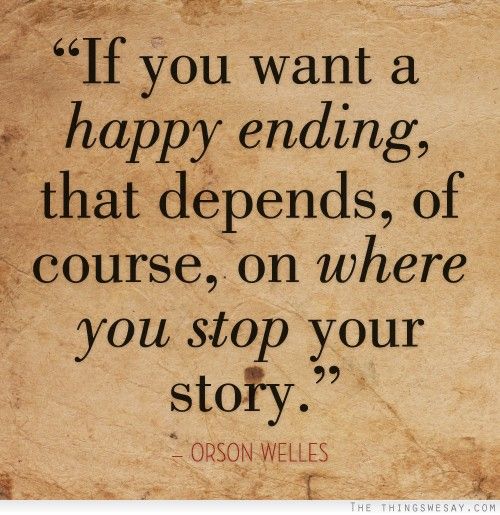
A good ending to a plot must be both inevitable yet surprising. 

I’ve been pondering this paradoxical advice since ever since.

Thriller writer, Meg Gardiner, (also interviewed in the NYT Podcast) summed up the above axiom in her 2015 blog post as: 

Amazing! Not what I expected, but exactly what I expected.

Try putting your favorite books and movies to this test.

For me, this played out in the novel Me Before You by Jojo Moyes(Don’t bother with the movie version.) It’s a contemporary romance between an unlikely pair who seem to hate each other at first then fall deeply in love. At the end of the book, one of the characters makes a choice that made me cry.  I thought about it for days. At first, I was sure it was the wrong ending. But as I reflected  (and debated with a friend), I could see the author had planted the seeds for what was to come. The reader doesn’t want this ending, is hoping until the last page that it won’t happen, but it does.  The conclusion is unsettling, thought-provoking and, indeed, “inevitable, yet unexpected.”

Few endings, in fiction or life, are perfect.

Story endings can leave us sad and still be a good ending. Or, perhaps, the right ending.

What are your favorite or worst book/movie endings? 

If you’re a writer, do you plan the ending ahead of time?

The_End2.jpg

Where Do You Get Your Ideas?

ideas2One of the most common questions I’m asked when people hear I write fiction is: Where do you get your ideas?  The answer is simple: ideas are never the problem. I have too many ideas.

While smack in the midst of  the draft of my second novel, I got an idea of another book. I was really excited about the idea, but I forced myself to put it on hold.

Where do I get my ideas?  In snippets of conversation overheard in a coffee shop. Newspapers stories. Obituaries. Historical events. Dreams. Childhood experiences. Traveling. Imagination. Art. Issues I care about.

When my writing workshop students get stuck, here are some ways I help them generate  ideas.

l.  Ask What if?  What if you find out your best friend was living a double life? What if you discovered you suddenly could speak a language you were never taught? 

2. Collect interesting images of people whom you do not know. Decide to bring one to life. What is her name?  What does she want most in the world? What is her story? 

3.  Collect images of awesome, weird, and intriguing places. Use the image as a jumping off point for a setting. What is magical about this place? What happened there?

4.  Think of a funny incident that happened to you. Now retell the story with a different character and ending.

5.  A character receives a map in the mail. Describe the map. Who sent it? Why?

6.  Look for story starters.  Here is one I gave my students for a flash fiction lesson. She gave me the black box for my birthday.  This opening generated many creative short pieces!

7.  People watch. (My students are always surprised when I admit to eavesdropping in public places.) Imagine a secret someone may be keeping? 

Most likely, you’ll have more story ideas than you’ll ever have time to write. (I certainly do.)

I think most writers would agree that ideas are all around us if we take the time to look. The real challenge is not in finding the idea but in shaping it into a compelling story.

Beginning writers put too much emphasis on finding the idea. The story idea is only the first step of your journey. The real story unfolds during the long trek to The End. One of the fun things about writing fiction is the process of discovery. You may think you know where your character is going until she grabs the reins and changes direction.

When I was working on my novel One Is Not A Lonely Number, I knew the character Gabrielle has a secret. I just wasn’t sure what it was. I kept on writing the story, thinking about Gabrielle, listening to her, until one day I just knew. It felt magical.

Stephen King writes about this process of discovery in his memoir On Writing :“…my basic belief about making stories is that they pretty much make themselves.” He starts with the situation first and then develops the characters. And he never knows the ending ahead of time.

So don’t sit and stare at the blank page. Start writing something. Anything. Don’t over think the process. Just keep writing. Ask yourself questions along the way. Let your idea morph into other ideas. See where your characters lead you.

Enjoy the journey!


Raising an Entrepreneur: My daughter Leah Larson

I’m busy working on my presentation for the State of Maryland International Reading Association Conference. I’ll be speaking with my daughter, Leah Larson Caras, founder and publisher of Yaldah Media, Inc., Wed. March 26th 2012.

Topic: A Parent’s Dream. 

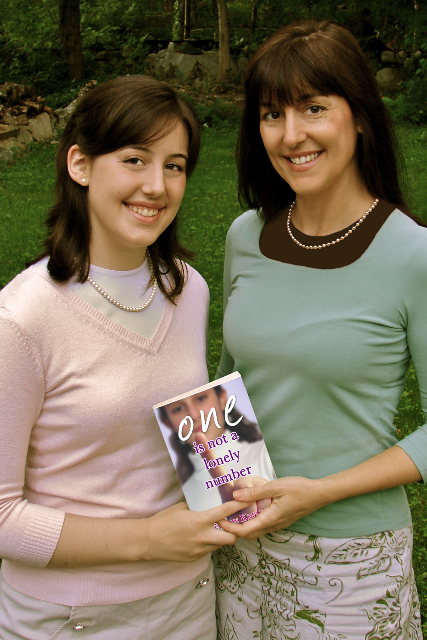
I’ll trace my journey from teaching first grade to publishing my first novel while raising an entrepreneur.  Thurs. evening I will talk about my book, One Is Not A Lonely Number, along with a slew of other children’s authors at the Author’s & Desserts event.

Looking forward to meeting inspiring educators and authors. Let me know if you’ll be attending or in the Baltimore area.