The Geometry of Grief

I turn on the local Saturday evening news after 24 hours of being unplugged. Lead story is: “Cambridge woman killed Friday afternoon while biking in Boston.”  A beloved, longtime Brookline librarian. Her photo flashes across the screen.

That’s my old friend!  That’s Paula. No, it can’t be.

I stand there trying to absorb the story. Police. Accident scene. Hit by a cement truck. Friends giving tribute. Boston cyclists mourning, calling for safer intersections…

Now I’m crying.

Paula_Sharaga_Librarian
Pubic Library of Brookline

I met Paula Sharaga when my kids were young. She was the new children’s librarian our local library.  I liked her quirkiness and warmth.  Paula and I were both early childhood educators, active in the Jewish community, and, of course, book lovers. We had lots to talk about.  Sharing our family Rosh Hashana dinner with Paula just after the tragedy of September 11 is a special memory.  

Later, Paula moved to Cambridge and took a job at the Brookline Public Library. This meant we didn’t see each other much. Our friendship, like many others, shifted to email and Facebook. And then, gradually, our contact lessened.

Strangely, just a few weeks ago, I thought of Paula for some reason. I realized it had been a long time since we chatted. I made a mental note to reach out.

I never did.

Now Paula’s Facebook page is filled with expressions of sympathy, sadness, and memories. I’m awed by the outpouring of love. 

Scrolling through her page, I’m quickly updated with all she had been involved with the past years.  Environmental activism. Politics, protests. Nature hikes. Cycling. 

Paula_Sharaga_activist

I see that she married her long-time boyfriend.  I read his words of shock and disbelief.  Paula’s husband is now in the After.

I know that place well.

You are thrust into that place with a simple phone call. 

Now I  pray that Paula’s husband is surrounded by love in the After. That the intense grief from losing his wife and her abrupt, tragic ending will not shadow the eventual light. 

I hope no one will say to him: “It was G-d’s will,”  or “She’s in a better place,” or “Let me know if I can do anything.”  (Just do something!)  I hope no one will count the months or years of his grieving and tell him “it’s time to move on”.

No one ever knows the right thing to say to someone in mourning. The Jewish custom provides a simple script: “May you be comforted among the mourners of Zion. May her memory be a blessing.”

Paula_Sharaga1
Paul Sharaga Facebook

I leave you, dear readers, with my newest essay published by Women on Writing, which seems fitting at this momentThe Geometry of Grief.

Send Your Writing Into The World: Don’t Give Up

A short story by Evelyn Krieger, published in Gemini Magazine. “Mom is in our hotel bathroom fixing herself up.”

blogger

“A short story is a love affair; a novel is a marriage.”

I have a new short story publication to share. “Her Last Dance” appeared in the August issue of Gemini Magazine.

It’s scary sending your work out in the world.  First, there’s the inevitable rejection that’s simply part of the submission process. Happens to all writers, no matter how experienced or well-published. Keep revising and submitting. Get critiques. Don’t give up.

Even when your story, essay, article (or book) finds a home, you may wonder how it will be received.  This can be particularly concerning when publishing personal essays or opinion pieces.

So far, the response to “Her Last Dance” has been positive.  Gemini Editor David Bright said he and the judges were very moved by my story.  One reader commented on its “chilling ending”.  Another told me I had “nailed the teenage voice”.

The narrator’s voice came easily to me. I knew the POV had to be through the girl’s eyes.  I wanted the reader to empathize with the teen’s experience but also know more than she does.  Through the use of subtext, the reader can see what the girl cannot, what is truly going on.

The ending is what gave me trouble.

Once I employed the advice: a good ending should be surprising yet inevitable, I felt satisfied with my choice. (See blog post on story endings).

So here it is!  I’d love to know what you think. (Really.)


disco-ball

Her Last Dance

by

Evelyn Krieger


Mom is in our hotel bathroom fixing herself up. I smell her apricot perfume from outside the door. I’m supposed to get fixed up, too. No idea why Mom uses that expression, I mean, it’s not like we’re broken or anything. I bend over, let my dark hair fall forward, start brushing to make it fluffy like in those shampoo commercials. I check myself in the mirror, dab on bubblegum lip gloss, and a smudge of cherry blush.

     Then Mom comes out. “Well?” She spins around in her sleek black skirt. “What do you think?”

     I swallow.  Her dark eyes seem bigger, like they’re eager for something. “You’re taller.”

     “Hah! I haven’t worn spiked heels in ages. What about my outfit?”

     “You look pretty, Mom. Really.”  And she does.

     “Thank you, my dear.”  Mom squints into the mirror as she puts on her gold hoop earrings. “You’re never fully dressed with bare ears.”

      “Wish Dad could see you. Want me to grab the camera?”

     “No, don’t bother.” She steps back to admire herself.  “I don’t want him thinking we had too much fun.”                                       

     “How come you don’t get dressed up at home?” I ask.

     She looks at me, her perfectly penciled eyebrows raised. “And just where might I be going? Ballroom dancing?”

     I hate it when she gets snarky. “You could take Dad out. You guys stay home too much. I don’t need a babysitter anymore, for your information.”

      “For your information,” she says, “once upon a time your father and I used to go dancing every Saturday night.”  A shadow of sadness passes over Mom’s face.  “He was pretty damn good.”

     I try to picture my father dancing. Instead, I see him in his wheelchair spinning around the floor. He’s the one who needs fixing up. I don’t like to think about Dad home alone with just boring old Carol to dress him and tie his shoes. Mom says there’s no reason to feel guilty–this is our “well-deserved” vacation. Maybe she’s right. So far we’ve had a decent time visiting Chicago, but I am not sure I like the idea of meeting Malcolm.   

Click here to continue reading “Her Last Dance”.


How to Write a Great Ending: (Why Endings Matter in Fiction and Life)

Endings matter in fiction and life.

The_End

Why is it we can forgive a book’s slow start, a meandering middle, but not a bad ending?

Some endings leave you feeling cheated. Or disappointed. Or plain confused.

You’ve invested your time, money, and heart and you want a payoff at the end.  Endings matter to readers and movie-goers. A lot.  The highly ambiguous ending to the 2014 movie Birdman ignited an intense online debate about what actually happened. Some loved the ending, others hated it.

For years after publishing Gone with the Wind, author Margaret Mitchell was deluged with reader requests for a sequel. Mitchell adamantly refused, saying she purposely left the ending ambiguous because she had no idea whether or not Scarlet and Rhett would be reunited.

Gone_With_The_Wind

So what makes a bad ending? 

I asked my friends and family. Their answers aligned with the advice you’d get in a basic writing workshop.

-Confusing

-Based on coincidence

-It was all a dream

-Contrived

-Too many loose ends

-The hero dies without achieving or seeing his goal/dream

-Manipulative

-Unrealistic

-Too Sad

There’s a great scene in the movie The Silver Lining Playbook when the main character Pat, upon finishing Hemingway’s A Farewell to Arms, throws the book out the window. Pat then wakes his sleeping parents and launches into a rant over the love story’s bleak ending.

“…She dies, Dad! I mean, the world’s hard enough as it is, guys…Can’t somebody say, “Hey, let’s be positive? Let’s have a good ending to the story?”

Turns out, Hemingway considered at least 40 possible endings to the classic 1928 novel. If your curious, a 2012 Library Edition exists containing these alternative endings. 

This brings to mind the wacky physics theory of “parallel universes.   I won’t get into the scientific details behind the controversial concept, but basically, it explores the possibility that other versions of ourselves, our histories, and our outcomes exist simultaneously in multiple universes. (A premise portrayed many a time in science fiction tales.) 

So, let’s say you’re feeling sad and regretful about letting a lover go. Perhaps you can take comfort in the idea that somewhere out there your replica is enjoying life with this missed love.

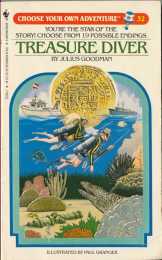
In the 1980s and 90s, the widely popular children series, Choose Your Own Adventure, allowed readers to assume the role of the protagonist.  Every few pages,  the reader gets to make choices that determine the outcome. The fun part is getting the chance to explore several possible endings.

Choose_Your_Own_Moon

                            Choose_Your_Own_Treasur_Diver


Each book’s introduction affirms the power the reader holds. 

“There are dangers, choices, adventures, and consequences…but don’t despair at anytime YOU can go back and alter the path of your story, and change its results. 

If only real life were like that.


How do writers craft the perfect ending to their story?

Some decide on the ending at the very beginning and fill in the rest. Others follow a detailed outline which builds to a specified ending. Others writers like to journey with their characters and allow the ending to unfold. The process becomes an exciting discovery.

Best-selling thriller writers Lee Child and Lisa Scottoline described this process in a recent NYT podcast. After getting a feel for the tone of the book, Lee Child just sits down to write and sees what happens.  Lisa Scottoline knows only the beginning when she starts writing a novel. As she reaches each new point, Lisa asks herself, “Okay, now what?”  The prolific author says this process mirrors life.

I rarely know the ending of a story before I write. Even if I have a sense of the story’s conclusion, I often change my mind or consider alternatives. In my novel, One Is Not A Lonely Number, one of the characters reveals a secret toward the end.  I didn’t even know what it was until I got there. 

In my new short story, “When We Were Bad”, I knew one of the characters would end up in the wrong place at the right time but wasn’t sure if she’d get out alive. Making that decision ultimately changed the final paragraph which I rewrote several times.

But even when you decide on the ending of your story, how do you know it works?

What makes a good ending?

This is a trickier question than what makes a bad ending. According to the character Holden Caufield in Catcher in the Rye,

“What really knocks me out is a book that, when you’re all done reading it, you wish the author that wrote it was a terrific friend of yours and you could call him up on the phone whenever you felt like it.”

I love this quote and have experienced the feeling myself.

The answers my friends gave me regarding a good ending were more about emotion–how a story ending left them feeling.

-Happy(ish)

-Enlightened

-Moved

-Astonished

-Transformed

-Curious

-Wishing it never ended

The most common answer was satisfied.  Hmm. Makes me think of a good meal. What is satisfying to one reader may cause another to toss the book out the window.

. If-you-want-a-happy-ending-that-depends-of-course-on-where-you-stop-your-story.-Orson-Welles
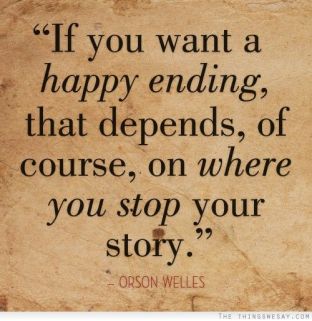
So how does a writer choose?

A while back, I came across an answer. 

A good ending to a plot must be both inevitable yet surprising. 

I’ve been pondering this paradoxical advice since ever since.

Thriller writer, Meg Gardiner, (also interviewed in the NYT Podcast) summed up the above axiom in her 2015 blog post as: 

Amazing! Not what I expected, but exactly what I expected.

Try putting your favorite books and movies to this test.

For me, this played out in the novel Me Before You by Jojo Moyes(Don’t bother with the movie version.) It’s a contemporary romance between an unlikely pair who seem to hate each other at first then fall deeply in love. At the end of the book, one of the characters makes a choice that made me cry.  I thought about it for days. At first, I was sure it was the wrong ending. But as I reflected  (and debated with a friend), I could see the author had planted the seeds for what was to come. The reader doesn’t want this ending, is hoping until the last page that it won’t happen, but it does.  The conclusion is unsettling, thought-provoking and, indeed, “inevitable, yet unexpected.”

Few endings, in fiction or life, are perfect.

Story endings can leave us sad and still be a good ending. Or, perhaps, the right ending.

What are your favorite or worst book/movie endings? 

If you’re a writer, do you plan the ending ahead of time?
The_End2.jpg

Do You Need An Accountability Partner?

Accountability_Photo

Do you have something big you want to accomplish but haven’t?  Do you have trouble sticking to a long-term goal?

Last month, I wrote about finding inspiration when you are creatively stuck. One reader wrote me that she has no problem finding inspiration. “I’m filled with creative visions.  My problem is always follow-through, especially when the going gets rough.”    

As a writer, I relate to this predicament. Ideas come easily to me. The beginning stage of writing a novel is kind of like falling in love—everything is new and exciting.  Possibilities abound. 

But sticking with it through the long haul inevitably means experiencing frustration, disappointment, and dry spells. And yes, sometimes loneliness and despair.

Whether you’re trying to write your first book, save for retirement, lose 20 pounds, or train for a marathon, staying on track is the hardest part.  Meeting any long-term goal requires continual motivation, discipline, and fortitude. Let’s be honest–who has an abundant supply of these traits?

If you recognize yourself here, then you may benefit from an accountability partner.

An AP is a trusted individual who holds you responsible for achieving your goals. In working with an accountability partner, you identify goals, then come up with a short-term plan of action.

You then report your progress through regular checkpoints via email, phone, Skype, or in-person.

An accountability partner can also offer:

-Advice and perspective

-Ideas and resources

-A listening ear

-Support and motivation

-Brainstorming

Sometimes, an AP is just a kind soul who volunteers 15 minutes a week to keep you on track.

Then there’s the reciprocal partnership in which you serve as each other’s Accountability Partner. Psychological research backs up its effectiveness. Just finding a partner with whom to share your goals increases the likelihood that you will achieve them.

It’s  a lot more fun to take a daily power walk with a friend than go at it alone for 45 minutes. Knowing you must check in with your weight-loss buddy each week makes it easier to pass up that chocolate donut. Reporting your daily word count to a fellow writer keeps you glued to your laptop (and off Facebook). 

By working with an Accountability Partner, you are harnessing the power of positive peer pressure to motivate change.

Tips for finding an Accountability Partner:

Look to a trusted friend, neighbor, co-worker, classmate, or family member. If you’re a writer, try posting a request on a writer’s forum. Check out local writer’s groups. Network at a writing conference.  

Tips for Making it Work:

—Know what you want to get out of the partnership.

—Find a partner who is looking for similar goals/results.

—Find a partner who is in a similar place of experience.

—Decide on the method and frequency of communication.

—Be honest.

–Be willing to invest equally in the relationship.

 I recently found my Accountability Partner—or I should say, she found me.  Connie and I live 800 miles apart.  We email and talk on the phone. We share goals and next action steps. We identify challenges and offer each other feedback.

Why is it always easier to help someone else with her problem areas?

Though we are working on different types of writing projects, the process is similar.  We both must make time for our writing and avoid distraction. We both need to track our word/page count. We both must troubleshoot and problem-solve. 

Since I have a lot more writing and publishing experience than Connie, I’ve had to identify the areas in which she can best help me. I won’t be looking to her for critique—I’ve already found someone for that. 

Rather, it’s the act of stating my goals out loud to another human and reporting my progress that matters.  If I don’t complete my stated goals, Connie helps me figure out why. Her coaching background offers me techniques for deciding which projects I should invest my time in.

In turn, I suggested that we each track our time and keep a Got Done list.  Already, I’ve noticed an uptick in my productivity.

This new relationship is a work-in-progress.  The only challenge so far is that Connie and I really enjoy talking to each other, so phone meetings go off in many directions. Maybe this just means that, in addition to finding an AP,  I’ve made a new friend.

Have you worked with an accountability partner? If so, what were the results?

Finding Inspiration for Creating Art

Inspiration_2018


“There were so many frightful times when I was totally “unilluminated” and feared that I could never write again.”   

                     ~Carson McCullers, Illumination and Night Glare


Where do you find inspiration when the well is dry, the light dim?  How do you engage in creative work amidst the onslaught of headlines of terror attacks, mass shootings, natural disasters, and White House insanity?  As you attend to the relentless demands of everyday life, how do you carve space for illumination?

Here are some of my ideas and those gleaned from other writers and artists.

l.  Start the day with beauty.

flowers-background-butterflies-beautiful-87452

Do you start the day with the news report? Is your phone screen the first image your eyes take in?  This is a hard habit to break but doing so can do wonders for your mood and muse. I know it’s hard to think about beauty when you’re getting ready for work or trying to get the kids off to school. But taking a moment to notice beauty, rather than the news headlines, can lift your spirit.

Instead of checking your Twitter feed, try feeding your soul.  Take in scenes of nature.  Research studies have demonstrated that just looking at nature scenes can reduce stress and increase pleasant feelings. This alone may open the door to inspiration. 

The beauty of language soothes and inspires me. Every morning at breakfast, I try to read a poem. This warms up my brain for creative work which, for me, is usually done early in the day. 

2.  Take A Walk

Walking has long been considered a way to open the mind. Naturalist, writer, and avid walker Henry David Thoreau wrote in his journal,  “Methinks that the moment my legs begin to move, my thoughts begin to flow.”  Walking is especially helpful for me when I’m about to begin a new writing project. Walking engages our senses, clears our mind of clutter, and gets the blood flowing—all helpful for finding that creative spark. (If you’re interested in learning more about the cognitive benefits of walking, check out Why Walking Helps Us Think, New Yorker, 9/3/14.) 

3.  Create a Playlist

It goes without saying that music can inspire.  Music can also serve as an anchor to a specific time in your life and take you right back to the associated emotions and memories. I’ve created mood playlists—melancholy, tense, romantic, happy—to help me get into a specific scene. Some writers use a specific playlist while working on a novel. Young adult author Rainbow Rowell’s main characters bond over 1980’s music. The author listened to these songs while drafting her novel, Eleanor & Park. (Rainbow shared the playlist with her fans on Spotify and YouTube.) 

4.  Learn from the Masters

StephenKing

All art is about craft, so learn your craft. Read wisdom from the masters–Virginia Wolfe, Anne Lamott, Stephen King, Chekov, Ursula Le Guin, John Gardner. Take solace that even the greats lose their muse (and sometimes their minds).  The successful artists you admire all doubt themselves, muddle through the middle, give up on manuscripts, have dry spells, and get rejected—just like you!   I keep several craft books near my desk. One of my favorites is Stein on Writing by Sol Stein.  When I sit down to write, I open one book to a random page and absorb the lesson at hand.  I also turn to my collection of inspiring quotes from writers and other creative thinkers.

And as imagination bodies forth

The forms of things unknown, the poet’s pen

Turns them to shapes and give to airy nothing

A local habitation and a name.

  ~William Shakespeare (A Midsummer Night’s Dream)

5.  Try Pen and Paper

If you always plan, outline, and compose on a computer, try paper and pen for a change. This not only removes the distraction of the internet, but also the delete button. (How many times have you deleted a sentence or idea 5 seconds after typing it?) Writing by hand forces you to slow down, to more closely consider your thoughts and feelings. And just by engaging a different process for creative inspiration, your brain is primed for novelty. You’re ready to brainstorm. Jot down every idea, question, and connection that pops into your head. Don’t censor. Explore all possibilities.

Nabokov_Quote


7.  Stay Curious

 Keep asking questions. Ask: What If? Read widely. Wonder. Talk to people who are very different from you. Jot down snippets of interesting conversation. Visit new places. Collect things. I like buying old postcards and photographs in antique shops and then imagining the stories behind them. 

7.  Show Up

Sometimes its best to just get started. Make art a daily companion, not an occasional visitor. Instead of saying “someday”, choose someday—like today.  Or as Stephen King bluntly states: “Amateurs sit and wait for inspiration, the rest of us just get up and go to work.” 

Exercise the writing muscle every day, even if it is only a letter, notes, a title list, a character sketch, a journal entry. Writers are like dancers, like athletes. Without that exercise, the muscles seize up.      ~Jane Yolen

8.  Trust the process.

If you’ve ever suffered from insomnia, you know how the anxiety of waiting for sleep and worrying that it won’t come actually delays its arrival. I think the same can be true for inspiration.  Instead of fretting that you don’t have the idea, the words, the vision, the melody—you may just need to surrender. Be patient. Wait a while. Some ideas arrive banging on your door, others gestate for years. Keep listening.

 “The statue in the stone. How does the artist find that, see it, before it’s visible?”

                     ~Ursula K. Le Guin

And sometimes in order to go forward, you have to first meet the place where you are stuck and grapple with it on the blank page.

A_Place_of_Darkeness

 When my father was killed, I felt a part of me die with him. Afterward, I could barely speak, let alone write. Inspiration eluded me. Only after braving the demon, could I begin to create again. I didn’t want to write about the experience; I needed to.  Inspiration isn’t always rosy and warm. Inspiration can come from a place of darkness. And by entering this place with courage and vulnerability, you can create something that illuminates.

My latest writing is published in the December issue of Hippocampus Magazine.  It’s the hardest essay I’ve ever written.

How do you capture inspiration?