National Novel Writing Month–Yay or Nay?

Image

When I became a mother, I couldn’t wait for all the things I would teach my kids.

I wanted to introduce them to music, dance, and art. I wanted them to have happy associations with Jewish observance. I wanted to inspire them to be lifelong learners and book lovers.

What I didn’t expect was how much my kids would teach and inspire me. My oldest daughter encouraged me to write a children’s novel which resulted in an award-winning book.

My son continues to inspire me to not “sweat the small stuff” and to stay positive.

My youngest daughter taught me to trust that she is learning, even though she is not in a traditional school.  Lately, she has been a beacon of light as I crawl through the tunnel of discouragement regarding my second novel  attempt. She understands my battle with perfectionism and, fortunately, does not seem to suffer from that condition.

“You need to try NaNoWriMo” she told me.

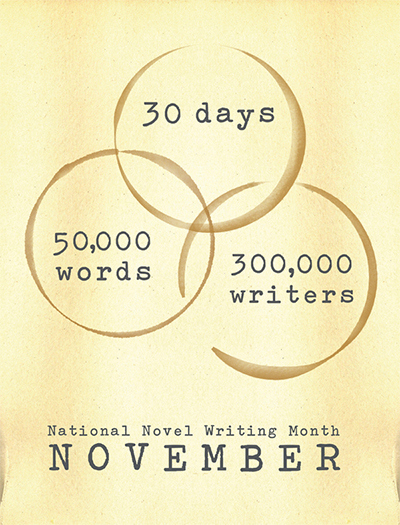
She was referring to National Novel Writing Month. Every November thousands of aspiring writers sign on to the project website. Their goal: write a quick first draft of a novel–in a month. That’s 50,000 words in 30 days!  Of course, not everyone succeeds, but the process itself is valuable–so they say.

“It’s all about silencing your inner critic. At least for a month,” Audrey tells me, fully aware of my nemesis.

Audrey has participated in the Youth Division for the past few years. She enjoyed the pep talks, the writing forums, and the rush of seeing her word count rise.

While I enthusiastically supported her participation, NaNoWriMo sounded like torture to me. I had several reasons for not signing on.

l.  I’ve already written a novel.

2. I’m not a fast writer.

3. I hate writing a big long mess.

4. November is a very busy month.

5. I have other writing contests to work on.

6.  I could never win.

7.  Did I mention that I could never write 50,000 words in a month?

You get the idea.

Of course, Audrey has a counter argument for each of my arguments.  “What have you go to lose?” she finally huffed, after I stubbornly clung to my excuses.

I was reminded of my father. Growing up, I suffered from a lot of worry.  Whether is was speaking in front of the class or trying something new, my anxiety would get in the way.

“What’s the worst thing that can happen?” my father would ask.

Which, today, inspired me to ask myself: What’s the worst thing that could happen by committing myself to NaNoWriMo? 

Answer: 1.  I write a bunch of garbage.  2. I don’t reach the goal.

Hmm. Not the end of the world by any means.

Then I suddenly thought of another question.  What’s the best thing that might happen? 

Answer. 1. I get back on track with the story I want to write. Even better: 2. I get in the flow and churn out a rough draft that gives me something to work on.

I hesitated to the last minute. I thought about being a role model for my writing workshop students (whom I encouraged to enter the Young Writers NaNoWriMo).

So I took the plunge and registered. This is my public announcement.

“Oy, “I’ll never write 50,000 words,” I said to Audrey immediately afterward.

“Mom!”

“Okay. I take it back.”

Image

The next day I got the first NaNoWriMo pep talk in my inbox. It was from award-winning YA author, Rainbow Rowell.

Wow, she was describing my every thought regarding National Novel Writing Month. Here’s an excerpt from her most excellent post.

Dear Writer,

I was very skeptical about NaNoWriMo at first.

It seemed like something that amateur writers would do. Or young writers. People who needed to be tricked into finishing     their books. I’d already written two books by October 2011, and sold them to publishers, and I couldn’t imagine writing either of them—or anything good—in a month.

That’s not writing, I thought, that’s just piling up words. But then I thought about how wonderful it would be to have a pile of 50,000 words… 

And guess what? Ms. Rowell’s NaNoWriMo first draft ended up becoming her recently published novel, Fangirl.

Her words hit my motivation button. Time to get writing.  Fast!

How do your children inspire you? Are you a NaNoWriMo participant?

Not Back To School: Unschooling

UnschoolingbusIt’s that time of year again– yellow buses, backpacks, lunch boxes, and first day of school jitters.

The back-to-school scene is a bit different in our household. My daughter begins her sophomore year of high school and her 9th year of homeschooling. No bus, no hall pass, no lunchroom, no recess, no homework.

She’ll be taking on a rigorous program of study tailored to her abilities and interests including ballet, music, screenwriting, and drama. 

Thanks to the many opportunities for homeschoolers in our area, my daughter has taken wilderness training, zoo school, MIT workshops, drama and art classes, and a host of field trips.

When we first began our homeschool journey. We grew to enjoy the flexibility and efficiency it offered. My daughter learned, explored, made friends, and honed her talents.

Since she began homeschooling, I managed to work part-time by teaching, consulting, and writing.

Homeschooling takes a lot of energy and time, but it also gives me a lot more time with my daughter. She is my youngest child and the only one not attending college. So, the time together is especially meaningful. Last year we took a field trip to Washington, D.C. which my daughter was responsible for planning.

When people hear that she is homeschooled, they often assume that I do all the teaching. Over the years, my daughter has had other teachers. She’s taken online courses, science and enrichment classes, joined study groups, and been involved in a school pilot program. Next year, she’s likely to take a community college course. Gradually, I’ve become more of a guide and coach to my daughter, as she directs most of her education.

And so, here we are today, on the college track, with full intention of a homeschool graduation in 2016.

As happy and well-adjusted as my daughter is, I still get bouts of parental angst (mostly 3:00 am).  Does she need a wider circle of friends? Is she getting a strong enough Jewish education? Will she know how to study for tests?  (She doesn’t take many.) Will she be fluent in Spanish? I even wonder if missing all that high school drama and the girl cliques will somehow put her at a disadvantage.

We all want the best for our children, so second-guessing our choices comes with the job description. Our desire to “get it right” sometimes makes us feel that others are getting it wrong. Read any article or news story on homeschooling and you’ll find commentators attacking this choice, claiming that it is inferior to public school, that children won’t be “socialized”, that we “shelter” our kids, on and on.

Never mind that they may have never even met a homeschooler before!

Underlying these negative comments and defensiveness (on both sides), may be our own insecurities. We want our choice to be the “right” choice.

I don’t question other parents’ school choice and I ask the same in return. I am fortunate to have a choice, and it’s what works best for our family right now.

Homeschooling is not for everyone. My choice not to send my daughter to traditional school does not say anything about your choice. I’m simply an advocate of learning,  whatever form it takes for your child to thrive.

Wishing you a successful and exciting school year!

Summer Reading Picks for Teens

It’s Book Bucket time again!

My daughter is just finishing up her homeschooling projects, so I haven’t yet presented her summer book bucket. Meanwhile, my Writing Workshop students have asked for summer reading recommendations.  So here you are:

Wonder

by R. J. Palacio

Knoph

Wonder

I fell in love with this book.  I listened to the audio version which was fantastic.  This story has heart, humor, and wit. It is the kind of book you want to talk to someone about after reading.  The story is told in multiple perspectives–from the main character, August, a fifth grader, his classmates, and  his sister in tenth grade.  So there is a wide range of interest here. Auggie has struggled all his life with a facial deformity which prevented him from attending school.  When he begins Beecher Prep, he hopes to be treated like a normal kid and to make friends. The story deals with friendship, bullying, empathy, teachers, and how a family copes with adversity and illness.  The author called her debut book, “a mediation in kindness”. I’d recommend it for both girl and boys ages 10-14, but adults will love it, too.  Wonder has been on many top ten lists this year. Don’t miss it.

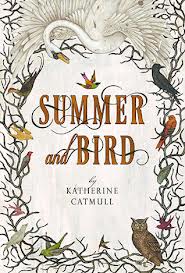
Summer and Bird

by Katherine Catmull

Dutton 2012

summer and bird

A beautifully written fairy-tale about two sisters, Summer and Bird, who awake one morning to find their parents missing. They embark on a mysterious quest through a forest to find them.  The girls are then pulled into a fantastical bird world called Down, where birds speak and connect with humans.  The sisters alternate chapters in telling the story.  This is a great book for girls who enjoy fantasy, nature, and relationship stories. It has emotional intensity and dangerous situations. Ages 12 and up.

The Agency, Book 1

 Y.S. Lee

Candlewick Press, 2011

the agency

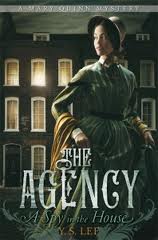
It is the 1850‘s London and twelve-year-old Mary Quinn is sentenced to hang for stealing. In the nick of time, she is secretly rescued by a member of the covert spy group called The Agency.  Working under the guise of Miss Scrimshaw’s Academy for Girls, the all female agency trains young females to be spies. Mary’s first assignment is to disguise herself as a lady’s companion and infiltrate a rich merachant’s home in order to uncover the mystery of some disappearing cargo ships. This is a great book for more sophisticated readers who enjoy historical fiction with romance and suspense. The lush details will transport you back to Victorian-era London.  Recommended for ages 12-18.

Code Name Verity

by Elizabeth Wein

Hyperian 2012

Code name verity

This Printz Honor book has made a number of top ten lists. It will keep you hooked to the very end. After surviving a plane crash, “Verity”, a young female spy, is captured in  Nazi-occupied France. In exchange for a lesser form a torture and a stay of execution, Verity agrees to write her confessions about her espionage work. We learn the story of how she crossed paths with Maddie, the young pilot of the plane and why Verity abandoned her after the crash. Will trading secrets with the enemy save Verity’s life? This multi-layered adventure story is quite a grown-up one, so I recommend it for 14 to adult.

Close to Famous

by Joan Baur

Viking 2011

almost famous

Twelve-year-old Foster dreams of growing up to become a celebrity chef despite her reading disability. Set in a rural town of West Virginia, where Foster and her mother move to escape an abusive boyfriend, the story is full of odd and memorable characters. You’ll fall in love with Foster, the narrator, with her big heart and pillowcase full of secrets. Can the quirky townsfolk of tiny Culpepper help Foster realize her delicious dreams?  Ages 10 and up.

The Great Wall of Lucy Wu

by Wendy Wan-Lon Shang

Scholastic 2011

great wall of lucy wu

Lucy Wu is a sixth-grade girl with a strong will and great ambition. This girl has plans for her future which include becoming a basketball player  and an interior decorator. Alas, everything seems to get in the way, from having to share her room with Yi Po, her grandmother’s sister, to dealing with the school bully. Then there is the dreaded Chinese school her parents force her to attend. Lucy will make you laugh as she navigates her bi-cultural life with flair. Ages 9-12.

Legend

By Marie Lu

Putnam, 2011

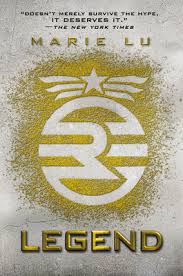
legend What would a summer reading list be with out a dystopian thriller? Seems like some young readers can’t get enough.  If that’s the case, Legend, first in a trilogy set in futuristic Los Angeles, should satisfy.  It’s a roller coaster ride that doesn’t stop. Though predictable and familiar at many points, it has emotion and compelling characters. The story alternates between fifteen-year-old June, a prodigy from the wealthy district, and fifteen-year-old Day, a wanted criminal born into the slums. This highly-visual book seems destined for the big screen. For boys and girls ages 12 and up.

Has your child you enjoyed any of these titles? What are you reading this summer?  

Spring Cleaning Your Life

Passover and spring cleaning can inspire change and personal growth.

photo_spring-cleaning1It’s a very busy time of the year for traditional Jews. We are cleaning like crazy trying to rid our homes of any spec of hametz–aka “leavened bread” before Passover which begins, Monday night, March 24th. That means cheerios on the car floor, crumbs in the couch, backpacks, and the dreaded kitchen. We will sweep, vacuum, wash, and scrub to make our homes “hametz-free” for 8 days.  All this may sound a bit obsessive, and it is, but all part of “turning over” the house to Passover.  Call it Extreme Spring Cleaning.

At the same time, the rabbis caution that we shouldn’t focus completely on just the physical preparation: we have to prep ourselves. We need to get rid of the “spiritual hametz“–the parts of ourselves get in the way of growth. Think addictions. Bad habits. Negative thoughts that enslave us.

Why Is Matzah So Bland? - Passover

For me, personal hametz is an ongoing battle with perfectionism. This ailment makes me my own worst taskmaster. Since Passover is a time to celebrate freedom and redemption, letting go of perfectionism is a fitting goal. (Notice I didn’t say “perfect” goal?)

Recently I learned that Passover is considered another Jewish year.  A good time for spring cleaning your life.

 If you didn’t make New Year’s Resolutions on Dec. 31st, maybe the arrival of spring is a more meaningful time for you to make changes.  A non-Jewish friend told me she makes her resolutions in the weeks before Easter since that is a time for rebirth.  Another friend says he takes stock of his life every year on his birthday. What a great idea!

Do you have a special time of the year for renewal?

New Year’s Resolution Check-up–Are you still there?

March 8thWe are 67 days into the new year.  So how are your resolutions going?

Have you  made progress on the goals you drafted?  Or have you opted out already? If so, you have plenty of company. Researchers estimate between 40-50% of those who make them, fail.

Just after my wrote my last blog post, I noticed that everyone seemed to be writing, talking,or  tweeting about setting goals and resolutions.Turns out, it ain’t easy to form new habits and stick to our goals.  Why?

Human nature and our brains.

I found this research so fascinating that I’ve decided to pursue my Ph.D. (Productivity and Habit Development.) During the upcoming months, I’ll be reading several books and articles on the topic of productivity, habits, and goals. Then I’ll recap my findings here just for you. I’ll try out some of the recommendations, too, and share my results.

The first book I recommend is Succeed: How We Can Reach Our Goals by Dr. Heidi Grant HalvorsonSucceed cover Dr. Halvorson is a speaker, psychologist, author, and expert on motivation.  She uses brain and social science to explain why some people succeed and some don’t at achieving goals in every day life. Dr. Halvorson writes in an engaging style and uses examples from her own life. She’s funny, too.

What I really liked about this book is that the author shows how conventional thinking about goals can sometimes be counterproductive.  For example, we hear a lot about the importance of visualizing–think Oprah–making dream boards, thinking positively, imagining our success.  The problem with this strategy, according to Dr. Halvorson, is that we don’t have a realistic picture of the steps we will take or the obstacles we’ll encounter along the way.  We don’t visualize how hard achieving our goal will be!

This certainly resonates with me as I think about the unfinished draft of my new novel that I thought I’d complete last summer.

I invite you to join my in my 2013 Ph.D program.  Please share your ideas, experiences and recommendations.