Love At First Write

Beginning to write
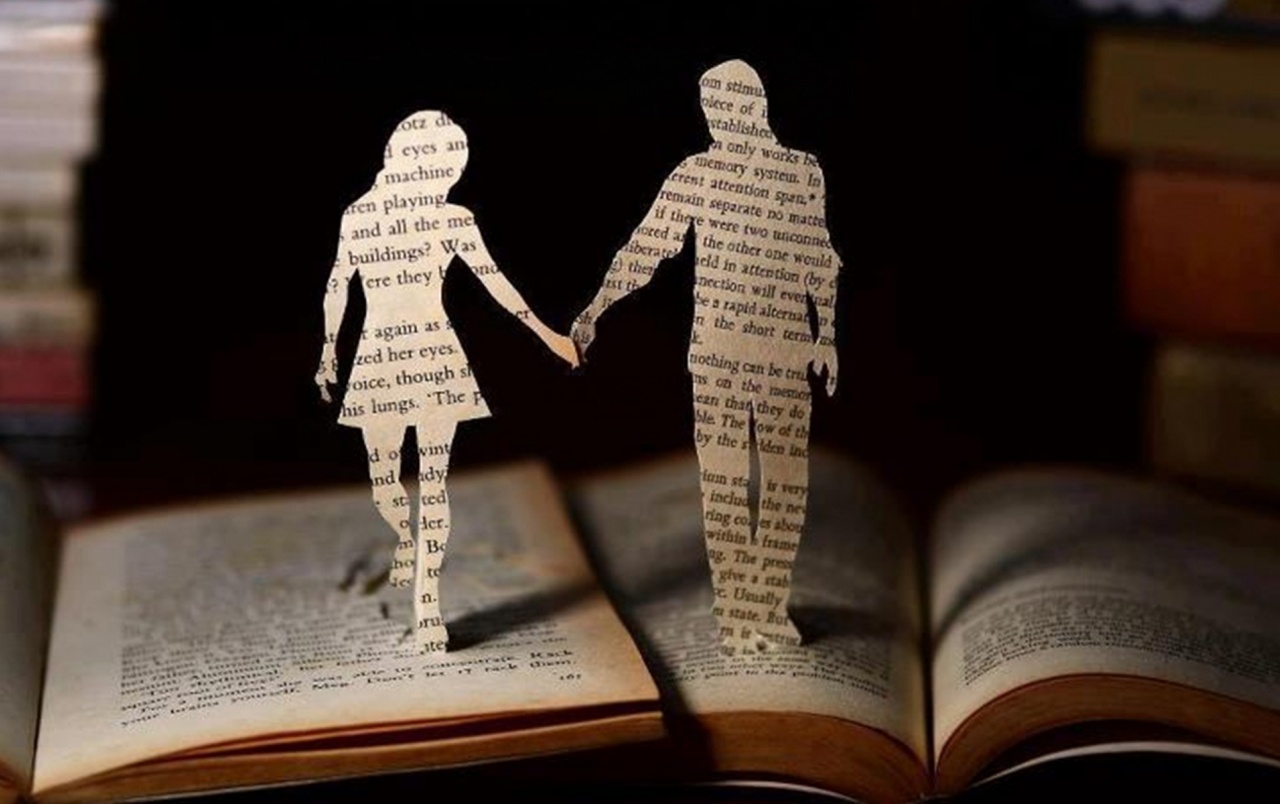
a novel is like a new romantic relationship.

BookLove

I’m enjoying a new romance. 

I can’t stop thinking about my love. I’m anxious when we’re apart. Our dates give me a high. The relationship feels shiny and new; so far I see no flaws.

You’d probably say I’m in the “honeymoon phase”.  And you’d be right.

My new love is not a man, though, (or even an adorable puppy).

It’s a novel. One that I’ve just started writing. We meet almost every day—at my desk, in the library or coffee shop. Sometimes in bed.

Previously, I’ve been through two long-term book relationships, each ending with publication.  I’ve had a few breakups along the way. And another relationship that ended after the honeymoon stage. Before meeting my new novel, I was separated from another one in-progress, 3/4 through the first draft, a story I believed in and still do.

So what happened? 

I hit a rough patch—the inevitable muddy middle and couldn’t find my way out. And then life intruded, taking away my time. Then bad stuff happened, taking away my words. The bad stuff gave power to my inner critic, The more time passed that I hadn’t worked on this book, the greater my despair. We lost our connection. I began to associate the story with pain and loss, so that every time I opened my laptop, my chest tightened.

I decided to take a break.

I went exploring. Studied my craft. Sought advice. I looked for inspiration. I nourished my soul. My heart opened. Then, when I wasn’t looking, I bumped into an old acquaintance.  The idea, notes, and first chapter had been sitting in a file for 6 years. And it still looked good. I felt a spark.

“Let’s meet for coffee,” I said.

Now I hear the main character’s voice in my head as I’m falling asleep.  I imagine future scenes of our story. I reread every word spoken so far. Sometimes while driving, I get so absorbed in thinking about the plot, I forget where I’m going.

Still, I worry about our future.

Heart_book-1760998_640

Just like some people are in love with the idea of falling in love, some people are in love with the idea of writing a novel. But for most, it remains just an idea. Writing the damn thing is really hard work. It takes a lot of time, self-discipline, and know-how. So you really need to fall in love with the story, at least in the beginning. And that’s just the writing part. Getting published requires a whole other set of know-how and connections. Even though I’ve been writing fiction for a long time, have studied the craft, won awards, and been published, I still find the process difficult, particularly trying to develop an idea for 300 pages…and doing it well. 

Of course, I am not alone in this struggle. And neither are you, if this is what you hope to accomplish.  Read enough author interviews and you’ll hear a similar lament. Doesn’t matter how many books they have under their belt, either. The spark of the new is exciting. It fuels ambition and optimism. But like any long-term relationship, you will hit a bump somewhere. You run out of things to talk about. You’ll partner’s flaws become magnified. Then one day you sit down at your desk and say, “What was I thinking?”

You fall out of love.

Writers_Block


There’s plenty of advice out there on navigating the midlife crisis of a manuscript (or any part of it, for that matter). As I noticed how similar my behaviors were to someone newly in love, I looked to the advice offered by marriage counselors to see if it might apply to writing through the rough patch.  Here’s what I found:

l.  Remember why you fell in love in the first place. 

    When you are stuck, rewind to the beginning. Write your mission statement for the novel. Think about the magical parts. Outline its future. Imagine the scenes yet unwritten.

2. Know that every relationship goes through rough times, some harder than others.

    Getting writer’s block, feeling stuck, disliking what you’ve written, are parts of the process of building a solid story. Calling it quits is sometimes necessary, but first, you have to ride the wave of uncertainty. Expect it. Make friends with it.  

3. Make time to nurture your relationship. 

    Saying that you’ll finish your book when the kids are in school, when you can quit your day job, or when you finish re-doing the basement, rarely works. You’ll eventfully, find another reason why “now” is not the right time—real or imagined. So strike when the iron is hot, even if that turns out to be 30 minutes a day or two hours on a Sunday. Meeting once a month is not enough to make progress. A year from now you’ll regret not having started.

4. Take a break if necessary.

     After putting in time and effort and you still feel stuck, try starting a new writing project. It’s like having a fling with no consequences. (What fun!) Then return to your book with renewed energy and fresh eyes. See how you feel.

5.  Get help.

The writing life can get lonely.  Working on a novel brings frustration and self-doubt no matter how experienced you are.  Don’t go at it alone. Find a critique partner. Join a writer’s group. Take a class or workshop. Attend a conference. Read guidebooks from those who walked the path.

5.  Don’t give up— at least without a fight.

    Sometimes the first novel is a warm-up, a learning experience. It becomes part of your past. Even great ideas may fizzle in execution. And not all books should be written. If you do decide to break up, at least you know you gave it your best. Then, you have to figure out what to do differently the second or third time around.  Maybe you’re hoping to finally meet the Right One. But how will you know? Writing a novel is as much a process of discovery as it is an act of creation. You will learn things about yourself. You’ll discover truths. You may create something you never thought possible, something more whole, real, and satisfying than earlier attempts.

heart_lock_alex-martinez-62348-unsplash.jpg


The beginning of any relationship is both exciting and scary. Starting a new job, moving to another city, adopting a dog, making a new friend, all carry uncertainty.  In a romantic relationship, this is amplified. Does she like me for me?  Can I trust him? Is she the one? Can I commit? Will he still love me when I’m sixty-four?

Unlike humans relationships, a romance with a novel puts you in control. The book will never abandon you.

And you always have the last word.~  

 

Writing-the-end_andrew-neel-609844-unsplash

Turning Darkness to Light through Story

Happy_Children

“One of the luckiest things that can happen to you in life, I think, is to have a happy childhood.”  ~ Agatha Christie

“Childhood is a very, very tricky business of surviving it.”  ~Maurice Sendak

What first comes to mind when you hear the word “childhood”?

I’m guessing you might answer: innocence, joy, play, fun, laughter, silliness, or wonder.

What about the word “depression”?

Childhood depression should be an oxymoron. But it is a reality for too many children and the parents who love them.

One of the special characteristics of children is that, unlike grownups, they don’t stay mad or sad very long. But some children are born with a brain chemistry, genetic makeup, or nature that make it difficult to experience the lightness and joy of childhood, no matter how loving and stable their home.

“We naturally want and expect children to be happy,” my writer friend Irene Buchine says, “and when they’re not, we try to do something about it. We buy them a new toy, do a fun activity, talk, give hugs. But sometimes we can’t fix the unhappiness, and this feels awful.”

Depressed_Child

Irene knows a lot about childhood depression. Her only son, now a young adult, showed symptoms of rage, frustration, sadness, and suicidal thinking by age eight. 

When other parents complained about their children’s everyday woes— not being picked for the travel team, not getting the lead in a play, having a squabble with a friend, being too shy—Irene was struggling to keep her child from despair.

“I couldn’t relate to these parents. I felt alienated,” she said. “My son and I lived in a bubble of silence outside the norm.”

  Irene’s parenting world revolved around psychiatrists, therapy appointments, hospitalizations, and various medications. She fought to protect her son in public school where he was often mistreated and misunderstood.

“While some teachers were invested in him, others lost patience.”  Irene advocated tirelessly on her son’s behalf to keep him safe. “There were times,” she told me tearfully, “when I honestly didn’t know if I was going to lose him.” 

I met Irene a year and a half ago at a local meet-up of SCBWI (Society of Children’s Book Writers and Illustrator).  She’s a petite powerhouse who radiates energy and warmth. We immediately connected.  As we got to know one and other, we shared, not only our writing goals but our personal journeys of struggle and growth. Listening to Irene’s story, I marveled at her ability to exude such a love for life.

Irene has turned her painful experience into a passion project to help others. She wants to shed light on childhood depression, to open the uncomfortable discussion, and to let other parents and children know they are not alone. 


She translated this desire into action by writing and illustrating a small book with a big message. Celia and the Little Boy is the story of two children trapped in the darkness, and what it took for them to find their way out.”  Illustrated with child-like pencil drawings, this timeless tale is for readers ages 8 to 98. img_69311.jpg

Last week, I attended Irene’s book launch at the Canton Public Library. Speaking to a room full of supporters, Irene shared the story’s journey from inspiration to draft to published book. Irene’s son, now an adult, fully approved of her sharing his story, which is also his mother’s story.  

Irene read the Celia and the Little Boy aloud while the pages were projected on a large screen.  I could just feel the overwhelming emotion of the audience as Irene read the last, hopeful sentence. 

The next step in Irene’s passion project is to connect with parents, teachers, pediatricians, and therapists.  Irene wants to offer, not only hope but information on this devastating illness that impacts families and communities at both the personal and national level.

 IMG_6921

We can all learn from people like Irene who, rather than allowing themselves to be pulled under, reach toward the light. They turn pain into healing and meaning. They become activists, mentors, volunteers, writers, and spokespersons driven by a sense of purpose. They use the lessons gleaned from their loss, grief, or struggle to help ease another’s burden.

Now I think I know how Irene maintains her inner joy. Like her book character, Celia, Irene feels the struggle, yet is still able to see the world as a “truly wondrous place”.  

As she so eloquently writes in her dedication:  For all the children who dwell alone in the darkness and those who can see them.”

happychild2

For more information on Celia and the Little Boy Irenebuchine.com

Do You Need An Accountability Partner?

Accountability_Photo

Do you have something big you want to accomplish but haven’t?  Do you have trouble sticking to a long-term goal?

Last month, I wrote about finding inspiration when you are creatively stuck. One reader wrote me that she has no problem finding inspiration. “I’m filled with creative visions.  My problem is always follow-through, especially when the going gets rough.”    

As a writer, I relate to this predicament. Ideas come easily to me. The beginning stage of writing a novel is kind of like falling in love—everything is new and exciting.  Possibilities abound. 

But sticking with it through the long haul inevitably means experiencing frustration, disappointment, and dry spells. And yes, sometimes loneliness and despair.

Whether you’re trying to write your first book, save for retirement, lose 20 pounds, or train for a marathon, staying on track is the hardest part.  Meeting any long-term goal requires continual motivation, discipline, and fortitude. Let’s be honest–who has an abundant supply of these traits?

If you recognize yourself here, then you may benefit from an accountability partner.

An AP is a trusted individual who holds you responsible for achieving your goals. In working with an accountability partner, you identify goals, then come up with a short-term plan of action.

You then report your progress through regular checkpoints via email, phone, Skype, or in-person.

An accountability partner can also offer:

-Advice and perspective

-Ideas and resources

-A listening ear

-Support and motivation

-Brainstorming

Sometimes, an AP is just a kind soul who volunteers 15 minutes a week to keep you on track.

Then there’s the reciprocal partnership in which you serve as each other’s Accountability Partner. Psychological research backs up its effectiveness. Just finding a partner with whom to share your goals increases the likelihood that you will achieve them.

It’s  a lot more fun to take a daily power walk with a friend than go at it alone for 45 minutes. Knowing you must check in with your weight-loss buddy each week makes it easier to pass up that chocolate donut. Reporting your daily word count to a fellow writer keeps you glued to your laptop (and off Facebook). 

By working with an Accountability Partner, you are harnessing the power of positive peer pressure to motivate change.

Tips for finding an Accountability Partner:

Look to a trusted friend, neighbor, co-worker, classmate, or family member. If you’re a writer, try posting a request on a writer’s forum. Check out local writer’s groups. Network at a writing conference.  

Tips for Making it Work:

—Know what you want to get out of the partnership.

—Find a partner who is looking for similar goals/results.

—Find a partner who is in a similar place of experience.

—Decide on the method and frequency of communication.

—Be honest.

–Be willing to invest equally in the relationship.

 I recently found my Accountability Partner—or I should say, she found me.  Connie and I live 800 miles apart.  We email and talk on the phone. We share goals and next action steps. We identify challenges and offer each other feedback.

Why is it always easier to help someone else with her problem areas?

Though we are working on different types of writing projects, the process is similar.  We both must make time for our writing and avoid distraction. We both need to track our word/page count. We both must troubleshoot and problem-solve. 

Since I have a lot more writing and publishing experience than Connie, I’ve had to identify the areas in which she can best help me. I won’t be looking to her for critique—I’ve already found someone for that. 

Rather, it’s the act of stating my goals out loud to another human and reporting my progress that matters.  If I don’t complete my stated goals, Connie helps me figure out why. Her coaching background offers me techniques for deciding which projects I should invest my time in.

In turn, I suggested that we each track our time and keep a Got Done list.  Already, I’ve noticed an uptick in my productivity.

This new relationship is a work-in-progress.  The only challenge so far is that Connie and I really enjoy talking to each other, so phone meetings go off in many directions. Maybe this just means that, in addition to finding an AP,  I’ve made a new friend.

Have you worked with an accountability partner? If so, what were the results?

Finding Inspiration for Creating Art

Inspiration_2018


“There were so many frightful times when I was totally “unilluminated” and feared that I could never write again.”   

                     ~Carson McCullers, Illumination and Night Glare


Where do you find inspiration when the well is dry, the light dim?  How do you engage in creative work amidst the onslaught of headlines of terror attacks, mass shootings, natural disasters, and White House insanity?  As you attend to the relentless demands of everyday life, how do you carve space for illumination?

Here are some of my ideas and those gleaned from other writers and artists.

l.  Start the day with beauty.

flowers-background-butterflies-beautiful-87452

Do you start the day with the news report? Is your phone screen the first image your eyes take in?  This is a hard habit to break but doing so can do wonders for your mood and muse. I know it’s hard to think about beauty when you’re getting ready for work or trying to get the kids off to school. But taking a moment to notice beauty, rather than the news headlines, can lift your spirit.

Instead of checking your Twitter feed, try feeding your soul.  Take in scenes of nature.  Research studies have demonstrated that just looking at nature scenes can reduce stress and increase pleasant feelings. This alone may open the door to inspiration. 

The beauty of language soothes and inspires me. Every morning at breakfast, I try to read a poem. This warms up my brain for creative work which, for me, is usually done early in the day. 

2.  Take A Walk

Walking has long been considered a way to open the mind. Naturalist, writer, and avid walker Henry David Thoreau wrote in his journal,  “Methinks that the moment my legs begin to move, my thoughts begin to flow.”  Walking is especially helpful for me when I’m about to begin a new writing project. Walking engages our senses, clears our mind of clutter, and gets the blood flowing—all helpful for finding that creative spark. (If you’re interested in learning more about the cognitive benefits of walking, check out Why Walking Helps Us Think, New Yorker, 9/3/14.) 

3.  Create a Playlist

It goes without saying that music can inspire.  Music can also serve as an anchor to a specific time in your life and take you right back to the associated emotions and memories. I’ve created mood playlists—melancholy, tense, romantic, happy—to help me get into a specific scene. Some writers use a specific playlist while working on a novel. Young adult author Rainbow Rowell’s main characters bond over 1980’s music. The author listened to these songs while drafting her novel, Eleanor & Park. (Rainbow shared the playlist with her fans on Spotify and YouTube.) 

4.  Learn from the Masters

StephenKing

All art is about craft, so learn your craft. Read wisdom from the masters–Virginia Wolfe, Anne Lamott, Stephen King, Chekov, Ursula Le Guin, John Gardner. Take solace that even the greats lose their muse (and sometimes their minds).  The successful artists you admire all doubt themselves, muddle through the middle, give up on manuscripts, have dry spells, and get rejected—just like you!   I keep several craft books near my desk. One of my favorites is Stein on Writing by Sol Stein.  When I sit down to write, I open one book to a random page and absorb the lesson at hand.  I also turn to my collection of inspiring quotes from writers and other creative thinkers.

And as imagination bodies forth

The forms of things unknown, the poet’s pen

Turns them to shapes and give to airy nothing

A local habitation and a name.

  ~William Shakespeare (A Midsummer Night’s Dream)

5.  Try Pen and Paper

If you always plan, outline, and compose on a computer, try paper and pen for a change. This not only removes the distraction of the internet, but also the delete button. (How many times have you deleted a sentence or idea 5 seconds after typing it?) Writing by hand forces you to slow down, to more closely consider your thoughts and feelings. And just by engaging a different process for creative inspiration, your brain is primed for novelty. You’re ready to brainstorm. Jot down every idea, question, and connection that pops into your head. Don’t censor. Explore all possibilities.

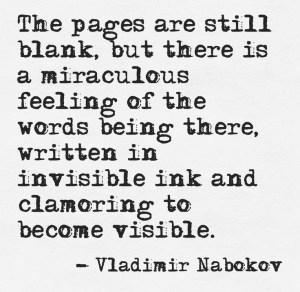
Nabokov_Quote


7.  Stay Curious

 Keep asking questions. Ask: What If? Read widely. Wonder. Talk to people who are very different from you. Jot down snippets of interesting conversation. Visit new places. Collect things. I like buying old postcards and photographs in antique shops and then imagining the stories behind them. 

7.  Show Up

Sometimes its best to just get started. Make art a daily companion, not an occasional visitor. Instead of saying “someday”, choose someday—like today.  Or as Stephen King bluntly states: “Amateurs sit and wait for inspiration, the rest of us just get up and go to work.” 

Exercise the writing muscle every day, even if it is only a letter, notes, a title list, a character sketch, a journal entry. Writers are like dancers, like athletes. Without that exercise, the muscles seize up.      ~Jane Yolen

8.  Trust the process.

If you’ve ever suffered from insomnia, you know how the anxiety of waiting for sleep and worrying that it won’t come actually delays its arrival. I think the same can be true for inspiration.  Instead of fretting that you don’t have the idea, the words, the vision, the melody—you may just need to surrender. Be patient. Wait a while. Some ideas arrive banging on your door, others gestate for years. Keep listening.

 “The statue in the stone. How does the artist find that, see it, before it’s visible?”

                     ~Ursula K. Le Guin

And sometimes in order to go forward, you have to first meet the place where you are stuck and grapple with it on the blank page.

A_Place_of_Darkeness

 When my father was killed, I felt a part of me die with him. Afterward, I could barely speak, let alone write. Inspiration eluded me. Only after braving the demon, could I begin to create again. I didn’t want to write about the experience; I needed to.  Inspiration isn’t always rosy and warm. Inspiration can come from a place of darkness. And by entering this place with courage and vulnerability, you can create something that illuminates.

My latest writing is published in the December issue of Hippocampus Magazine.  It’s the hardest essay I’ve ever written.

How do you capture inspiration?

POETRY WILL SAVE YOUR LIFE

Poetry_Will_Save_Your_Life_Cover

“Poems are made from the lives lived, borne out of experiences and shaped by solitary thought.” ~ Jill Bialosky

I just finished reading a wonderful new book that I picked up solely because of its intriguing title: Poetry Will Save Your Life by Jill Bialosky (Atria Books 2017). The  Kirkus Review sums it up well: “An emotional, sometimes-wrenching account of how lines of poetry can be lifelines.” 

This short memoir is centered on specific poems that have brought the author comfort, meaning, inspiration, or understanding during pivotal moments in her life. Bialosky organizes the book by themes such as Shame, Memory, Escape, Passion, First Love, and Mortality. A brief bio for each poet is included which deepens our awareness of the poem’s meaning. Each poignant chapter could stand alone. 

Throughout the book, Bialosky reflects on the profound lessons and meaning poetry can offer us. “Poems are composed of our own language disordered, reconfigured, reimagined, and compressed in ways that offer a heightened sense of reality and embrace a common humanity.”

Whether you are a poetry lover or haven’t read a poem since high school, there is something in this book for everyone. 

Ms. Bialosky, an award-winning poet, novelist, and book editor, never veers off into English professor mode when reflecting on the poems. Rather, she selects key phrases or themes that connect with her experience. Here she examines a stanza of E.E. Cummings poem, somewhere i have never traveled, gladly beyond.                

(i do not know what it is about you that closes
and opens;only something in me understands
the voice of your eyes is deeper than all roses)
nobody,not even the rain,has such small hands
                 

Bialosky explains that the “use of the word voice as a modifier for eyes allows the reader to experience how much the speaker of this poem “sees” into his subject. Then she intuits the poet’s question:  How is it that one person can unlock something private within us? Or awaken things in us we fear?” 

Bialosky writes about the death of her first child shortly after birth. She shares the never-ending pain of her beloved young sister’s suicide.  In the chapter of grief, Bialosky comments on Auden’s poem, Musee Des Beaux Arts. 

“W.H. Auden documents the otherworldly state of grief and tragedy; how it strikes families while others are doing the dishes or taking the dog for a walk. Even dogs continue on their doggy life.” 

Anyone who has experienced the death of a loved one can connect to this paradoxical state of being: How can everyone else just go about their business when my beloved is gone? 

Bialosky says, “I will spend years trying to capture the experience of suicide in a prose work…Poems remain a sustaining source of comfort.

Like Jill Bialowsky, words, too, have been an integral part of my healing after losing my father—words shared with a therapist, words of comfort from family and friends, words I have written, and words of those who have crawled through the tunnel of trauma and grief and come out the other side.

It has been exactly two years since my father’s tragic death. In some ways, this is unfathomable.  How could two years have passed?  This disbelief has me thinking more about the elusive nature of time. If time is constant, why do our brains perceive it so differently? Why does time slow down when we grieve and speed up when we are happy?  Why when we are waiting excitedly for a special event, do the days not move fast enough?          

passing-the-time

For centuries, poets have pondered time’s mystery. Consider Henry Van Dyke’s poem, Time Is.

Time is
Too Slow for those who Wait,
Too Swift for those who Fear,
Too Long for those who Grieve,
Too Short for those who Rejoice;
But for those who Love,
Time is eternity.

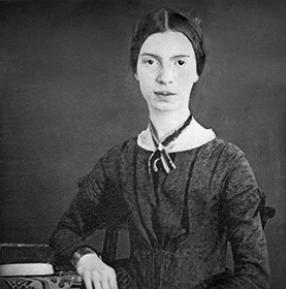
Emily Dickinson expresses this idea of expectation and waiting in her poem, If You Were Coming In The Fall.  Although the agoraphobic poet spent most of her life inside her Amherst, MA home, Dickinson enjoyed her share of romantic interests. The following poem is thought to be attributed to a family friend, Judge Otis Phillips Lord, who died 2 years before Emily.

EmilyDickinsonSmall


If you were coming in the Fall,

I’d brush the Summer by

With half a smile, and half a spurn,

As Housewives do, a Fly.

If I could see you in a year,

I’d wind the months in balls—

And put them each in separate Drawers,

For fear the numbers fuse—

If only Centuries, delayed,

I’d count them on my Hand,

Subtracting, till my fingers dropped

Into Van Dieman’s Land,

If certain, when this life was out—

That yours and mine, should be

I’d toss it yonder, like a Rind,

And take Eternity—

But, now, uncertain of the length

Of this, that is between,

It goads me, like the Goblin Bee—

That will not state— its sting.

                                            ~

Jill Bialowsy concludes that “poetry gives shape to those empty spaces within us that we have no words for until we find them in a poem.”  

Do you have a favorite poem or one that holds special meaning?