Author and Teacher. Inspiring creative souls through hard times.
Author: EvelynKrieger
I'm a people watcher and word crafter, author of fiction and essays. I also blog on living the creative life during hard times. When not writing, I work as a private educational consultant. Special interests: dance, the moon, astronauts, beaches, poetry, staying alive.
“Where you used to be, there is a hole in the world, which I find myself constantly walking around in the daytime, and falling in at night. I miss you like hell.”
~Edna St. Vincent Millay
We all experience grief and loss. Some of us more than others. There is no escaping its grip.
The longer we live, the more we lose.
The grief of losing a thing, and the fear of losing it,
are equal.”
~Seneca
In trying to comfort others, or share our grief experience, we get stuck in the sphere of emotion and physical sensation. How do we speak about grief?
We turn to metaphor and imagery.
A black hole. A sinking ship. A shredded heart. Time stands still. Grief eats like acid.
Sometimes, grief can be described in the same way as love.
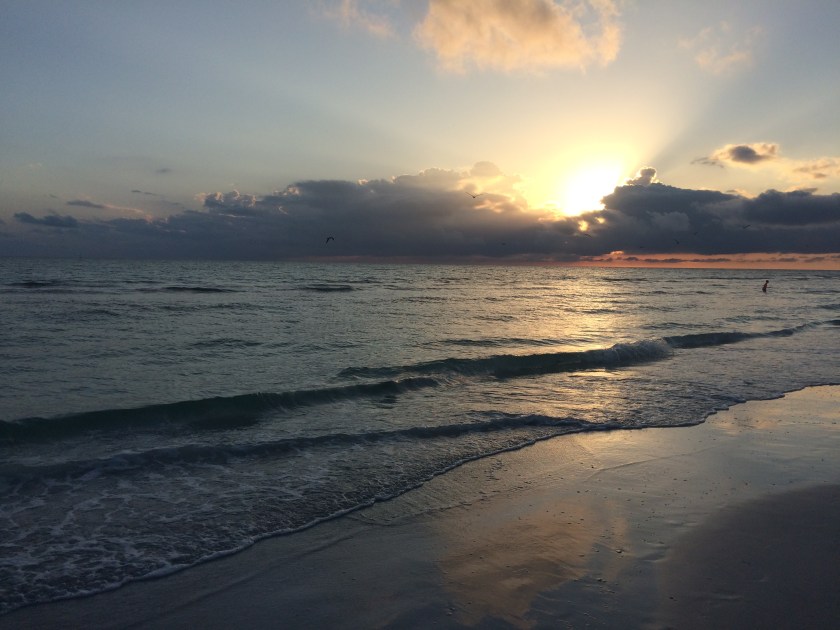
“Grief is like the ocean; it comes on waves ebbing and flowing. Sometimes the water is calm, and sometimes it is overwhelming.”
For is there grief without love?
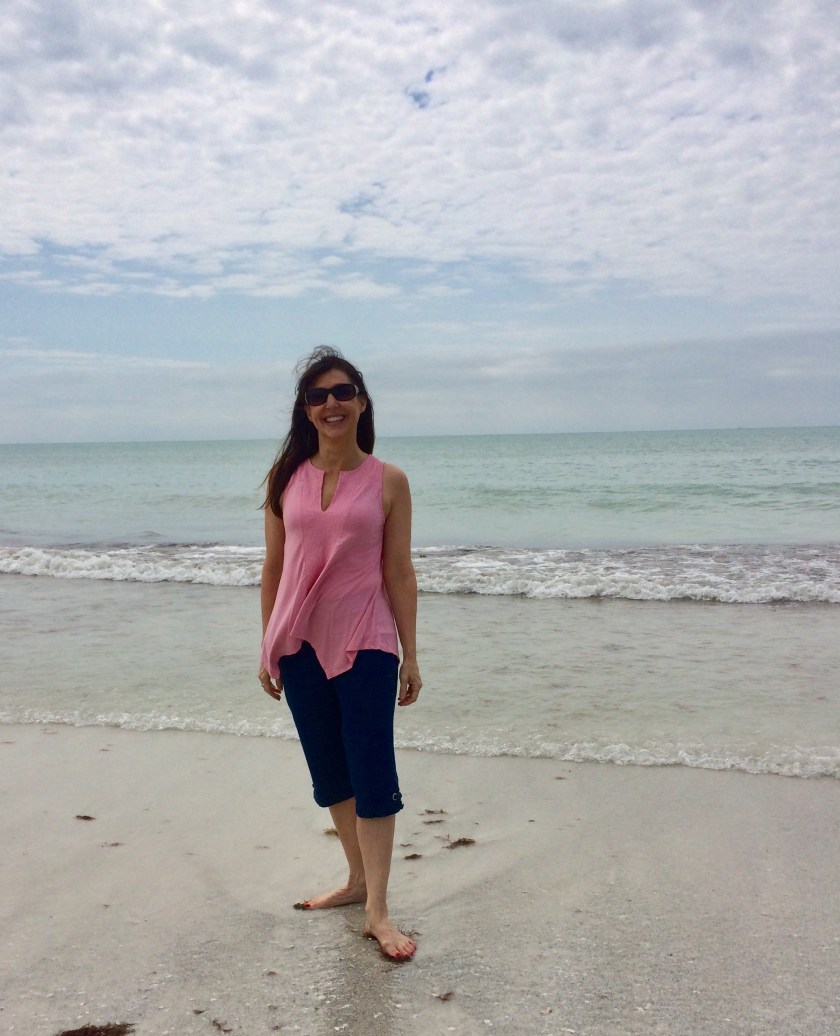
Siesta Keys Beach, FL
“All you can do is learn to swim.”
Author Anne Lamott writes, “You will lose someone you can’t live without, and your heart will be badly broken, and the bad news is that you never completely get over the loss of your beloved. But this is also good news. They live forever in your broken heart that doesn’t seal back up. And you come through. It’s like having a broken leg that never heals perfectly—that still hurts when the weather gets cold, but you learn to dance with the limp.”
In case you’re scratching your head…Pi Day falls on March 14. It’s as a celebration of the first 3 significant numbers of the math constant represented by the Greek letter π—3.14
Remember calculating the area of a circle?
Divide any circle’s circumference by its diameter; the answer (whether for a pie plate or a planet) is always approximately 3.14.
Pi has a rich history beginning in the ancient world. Some attributed magical meaning toπ. For a few thousand years, mathematicians have been scratching their heads over its properties.
Pi Day is celebrated around the globe with pie eating, math chats, contests, and related activities.MIT has been known to send out its admission decisions on March 14. San Francisco’s Exploratorium has an entire exhibit devoted to this mysterious number.
Could you compete in a Pi memorization contest?
This is a particularly impressive feat as there appears to be no repeating pattern in the constant.
Kids (and grownups, too) are fascinated by the idea that Pi never ends! In other words, if you write it out as a decimal, you’re going to need a ton paper.
3.1415926535897932384626433…
Maybe your children, or grandchildren, are lucky to have a school celebration today for this irrational number.
When my kids were home, I baked a pie on March 14.We explored circle art and puzzles.
From 74million.org
As an educator, I’m passionate about helping kids see math as more than arithmetic.As a private tutor, I’m often dismayed by the dull and relentless worksheets kids get for math homework.
And don’t get me started on the state of math education.
I advise parents not to leave their child’s math learning to school. Supplement and augment.
Kids need to develop a strong number sense. Make math a part of your daily life together: cooking, building, measuring, counting, estimating, banking, graphing, calculating, sorting, scoring, and shopping.
Introduce the language of math to little ones. No need to keep negative numbers a secret until sixth grade. Hey, it’s minus ten degrees in Boston!
Play with polygons and trapezoids and tessellations.
Audrey’s Geometric Display.
Read your kids and grandkids fun math-related picture books:
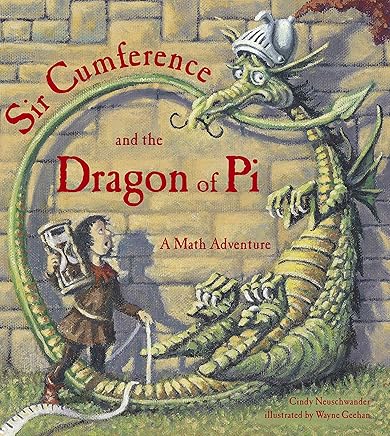
Sir Cumference and the Dragon of Pi by Cindy Neuschwander
T
The Grapes of Mathby Greg Tang
Circle, Square, Mooseby Kelly Bingham.
Count the Monkeys by Mack Barnett
Counting on Katherine: How Katherine Johnson Saved Apollo 13 by Helaine Becker
My favorite, for older readers–The Number Devil by Hans Magnus Enzensburger
In my middle-grade novel, One Is Not A Lonely Number, Talia, the 13-year-old narrator, is a math whiz who sees numbers in color with distinct personalities. While the story is about friendship, family, and faith, math plays an important role. I wanted to offer young readers a good story while presenting a girl’s love of numbers in a unique way. Kids write to me saying they enjoyed this aspect of the book.
.
How do you feel about math? What color is your favorite number?
I turn on the local Saturday evening news after 24 hours of being unplugged. Lead story is: “Cambridge woman killed Friday afternoon while biking in Boston.” A beloved, longtime Brookline librarian. Her photo flashes across the screen.
That’s my old friend!That’s Paula. No, it can’t be.
I stand there trying to absorb the story. Police. Accident scene. Hit by a cement truck. Friends giving tribute. Boston cyclists mourning, calling for safer intersections…
Now I’m crying.
Pubic Library of Brookline
I met Paula Sharaga when my kids were young. She was the new children’s librarian our local library. I liked her quirkiness and warmth. Paula and I were both early childhood educators, active in the Jewish community, and, of course, book lovers. We had lots to talk about. Sharing our family Rosh Hashana dinner with Paula just after the tragedy of September 11 is a special memory.
Later, Paula moved to Cambridge and took a job at the Brookline Public Library. This meant we didn’t see each other much. Our friendship, like many others, shifted to email and Facebook. And then, gradually, our contact lessened.
Strangely, just a few weeks ago, I thought of Paula for some reason. I realized it had been a long time since we chatted. I made a mental note to reach out.
I never did.
Now Paula’s Facebook page is filled with expressions of sympathy, sadness, and memories. I’m awed by the outpouring of love.
Scrolling through her page, I’m quickly updated with all she had been involved with the past years. Environmental activism. Politics, protests. Nature hikes. Cycling.
I see that she married her long-time boyfriend. I read his words of shock and disbelief. Paula’s husband is now in the After.
I know that place well.
You are thrust into that place with a simple phone call.
Now I pray that Paula’s husband is surrounded by love in the After. That the intense grief from losing his wife and her abrupt, tragic ending will not shadow the eventual light.
I hope no one will say to him: “It was G-d’s will,” or “She’s in a better place,” or “Let me know if I can do anything.” (Just do something!) I hope no one will count the months or years of his grieving and tell him “it’s time to move on”.
No one ever knows the right thing to say to someone in mourning. The Jewish custom provides a simple script: “May you be comforted among the mourners of Zion. May her memory be a blessing.”
Paul Sharaga Facebook
I leave you, dear readers, with my newest essay published by Women on Writing, which seems fitting at this moment—The Geometry of Grief.
How to make time for writing in your busy other life. Writing residencies at Vermont Studio Center.
I just spent the last month in a writer’s heaven. Nov. 2018
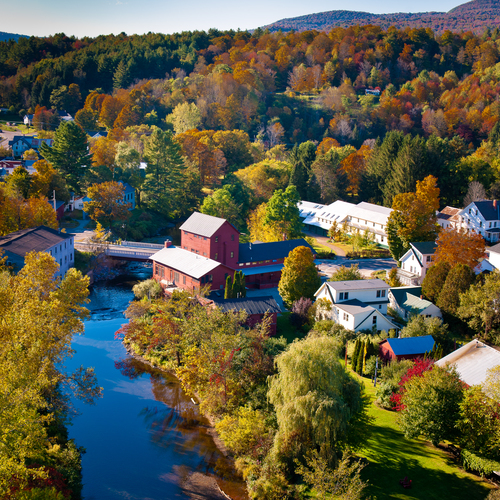
The Vermont Studio Center is the largest artist residency in the United States. Each month, 50 selected writers and visual artists from across the country and globe are offered unrestricted time for creative work.
I got to be one of them!
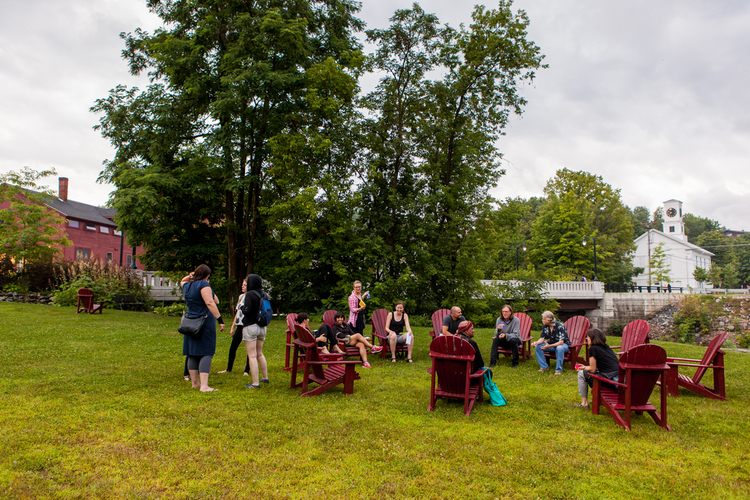
VSC provides private studios, room and board, conferencing with Visiting Artists, readings, craft talks, and presentation nights—all on its beautiful historic campus.
The first week, I was pinching myself.
Maverick Writing Studios
Amazing things happen when you get the chance to step out of your everyday life and write in a calm environment designed to limit distractions and obligations.
I learned a lot about myself as a writer.
I tested my mental stamina. I had time to just sit with the mess of words and ideas and try to shape it into something coherent and interesting. I learned how long it can take to write one decent paragraph, only to delete it the next day. I had the time and space to immerse myself in a fictional world.
Sometimes it was magical.
Other times, anxiety-provoking…What if it’s no good? Am I wasting my time?
My studio overlooking the river.
I met with Visiting Writing, Noy Holland, to discuss my short story in the revision stage. I got to spend time with other kindred spirits talking about the artistic process, rejection, failure, inspiration, and epiphanies. We shared stories, laughter, and tears.
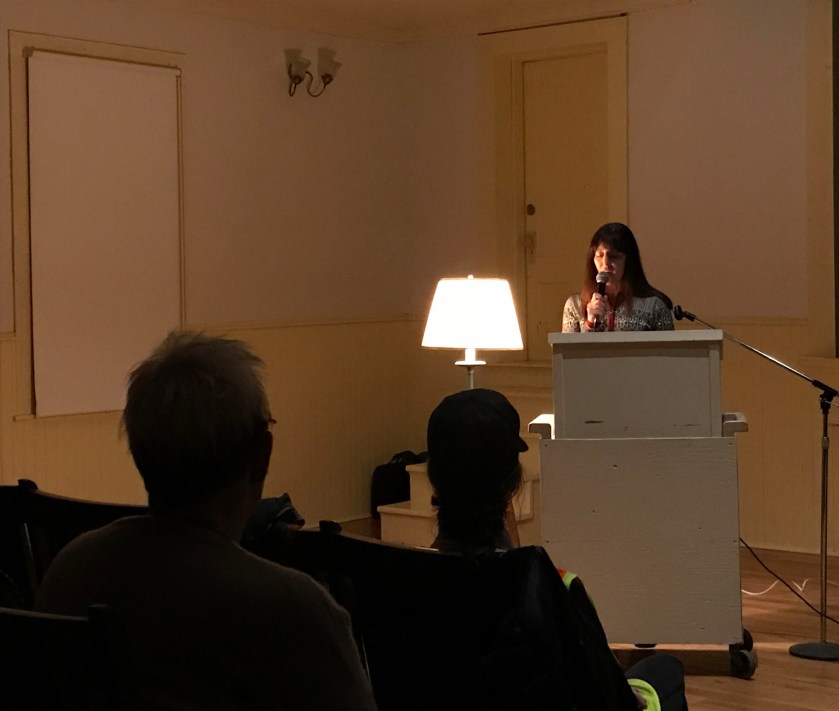
Resident Photos by Howard H. RomeraReading a new essay, “The Geometry of Grief”, at Presentation Night.
Finding time to pursue your passion amidst the demands of your present life is likely your number one challenge…or complaint.
But sometimes it serves as an excuse.
Saying, “My dream is to write a novel, but I simply don’t have the time right now,” is likely untrue, although it may feel that way.
As E.B. White once said: “A writer who waits for ideal conditions under which to work will die without putting a word on paper.”
While there are definitely periods in our lives when we feel especially stretched, finding time to write is possible if you make it so.
I’ve been writing and publishing since my late teens. That means I’ve written through college, graduate school, teaching career, raising 3 kids, homeschooling, and helping elderly parents.
There were times I was insanely busy, stressed out, or depressed. There were dry spells—sometimes long ones.There were also stretches of times conducive to creativity that resulted in publishable work.
Still…I wish I had accomplished more. (That’s Miss Perfectionist talking, so you can just ignore her.)
We all have the same 24 hours in a day.
“How we spend our days is, of course, how we spend our lives. What we do with this hour, and that one, is what we are doing. A schedule defends from chaos and whim. It is a net for catching days.” ~Annie Dillard, The Writing Life
Here are my tips for carving out time for writing:
Be a Time Sleuth
The first step to making time for writing is to scrutinize your daily/weekly schedule.
Can you wake up earlier before work or getting the kids off to school?
If early morning doesn’t don’t work for you, try writing in the evenings or late night hours.
If you commute by public transportation, consider that time. Keep a notebook with you for ideas and brainstorming.
Can you make time on the weekends?
Look for time suckers you can give up (or cut back on): The biggest one is the Internet Blackhole. Scrolling Facebook, Instagram, and Twitter. Endless newsfeeds. YouTube pet videos. Binge watching TV. Really.
Resit
Schedule your writing.
This next step is key. Once you find the times when you can write, mark it on your calendar.That’s right: you’re making an appointment with your muse. Begin with 15-minute blocks. That’s not long enough, you say? Believe me, the minutes add up. Consistency, more than quantity, matters at this stage.
Think of writing like exercise. You need to show up at the gym or class—whether you feel like it or not— in order to make progress. You can’t show up once a month and build muscle.Consistency leads to making a habit. The writing habit will help you achieve your goals. Show up, or as Stephen King said, “Butt in the chair.”
Designate a Writing Place
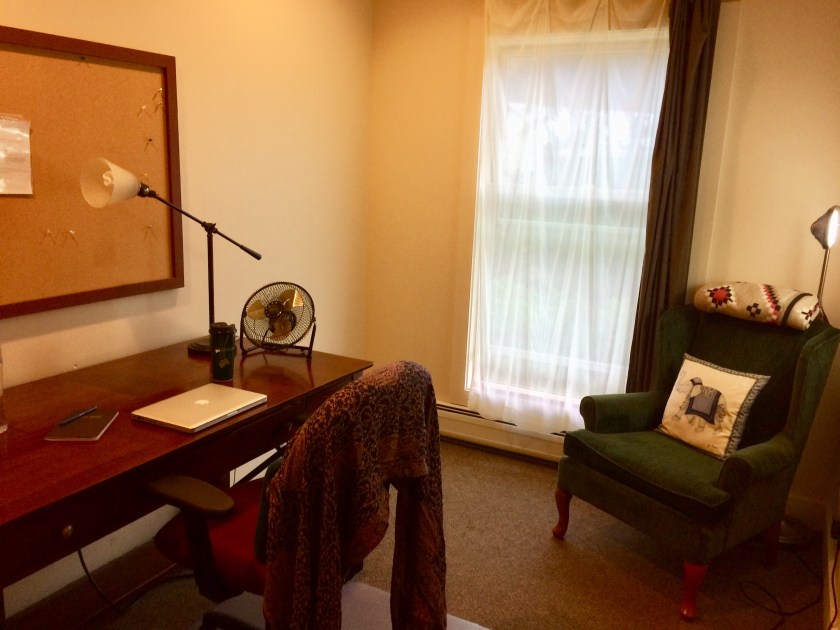
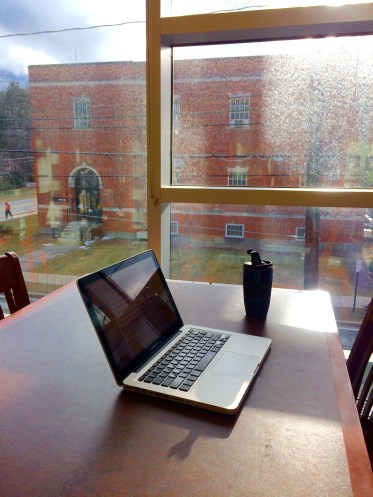
The great thing about writing is that it’s portable. I write in my home office, on the family room couch, in libraries and coffee shops. I’ve written in airports and on long bus rides. The place depends on my mood, what I’m writing, time of day, and schedule. Having a designated place to write, however, can help you build the habit. By associating a specific place for writing, your train your brain to switch into writing mode. Doesn’t matter if your place is a closet, office, or shed. Claim your space. Make it look and feel nice.
Sunny corner table of library = novel writing.
…Virginia Woolf had her room. Proust his shuttered windows. Marguerite Duras her muted house. Dylan Thomas his modest shed. All seeking an emptiness to imbue with words. The words that will penetrate virgin territory, crack unclaimed combinations, articulate the infinite. ~Patti Smith, Devotion
Set Goals & Deadlines
The process of trying to produce a piece of writing can be—no, make that will be—frustrating and discouraging.To stay on track you need to:
Define goals
Making a plan
Tracking progress
Set deadlines
Reward yourself
Again, the exercise analogy.If you just say, “I’m going to get in great shape”, you’ll likely to give up before you run the first race. You must make a plan with incremental milestones along the way.
Same idea for writing a novel. You start with the end goal in mind, then work backward. Name the date you want to finish by (I know, that’s really scary). Then break down the big goal into several small steps. Approximate when you’ll reach each step. Anticipate obstacles. Reward yourself when you arrive.Yes, you’ll likely have to adjust the steps and deadlines. The important thing is having a roadmap. (Thank you Kendra Levin for this advice.)
“Each time we come to the end of a piece of work, we have failed as we have leapt — spectacularly, brazenly — into the unknown.” ~ Danie Shapiro, Still Writing
Plan a Writing Retreat
Once you’ve made time to write, limiting distraction is the key to producing. A writing retreat can be a great way to jumpstart, revive, or finish a project.Some writers occasionally cloister themselves in a hotel room for a few days to binge write. I know two women who designed their own retreat by renting a cabin in New Hampshire. Poets & Writers Magazine has several classifieds ads for rentals in beautiful settings that cater to writers.
If you think you’re the right point in your life or career to pursue a writing residency, here’s a has a comprehensive listing.
How do you make time for writing or other creative pursuits?




 T
T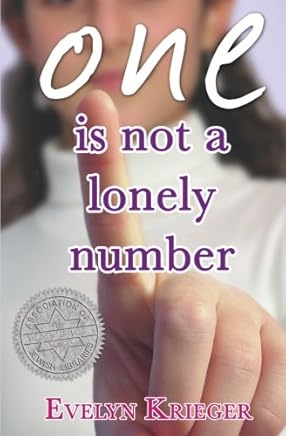










 EVELYN KRIEGER