

“Bittersweetness is the hidden source of our moon shots, masterpieces, and loves stories.” ~Susan Cain
In her early twenties, author Susan Cain began wondering why she found sad music strangely uplifting. From Leonard Cohen to Albinoni’s Adagio, mournful songs seemed to open her heart and inspire a sense of connectedness.
She spent the next two decades exploring how humans have turned sorrow into creativity, transcendence, and love.
Her new book, Bittersweet: How Sorry and Longing Makes Us Whole, examines not just why we experience the state of yearning, but how transforming our heartaches can help us turn toward each other and bring meaning.
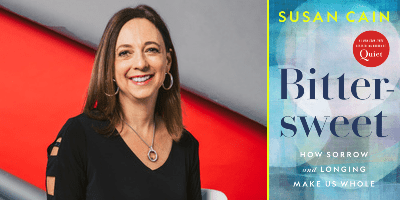
Do you have the bittersweet temperament? Cain offers a research-based quiz to see where you fall on the spectrum. Here are a few of the questions:
-Do you tear up easily at touching TV commercials?
-Are you especially moved by old photographs?
-Do you react intensely to music, art, or nature?
-Do you feel elevated by sad music?
-Do you seek out beauty in your everyday life?
My high score put me as a “true connoisseur of the place where light and dark meet.” Not surprising, at all. I was the kid who cried at Tchaikovsky’s “Swan Lake” theme.
Bittersweet is a word we often toss around. Cain’s precise definition really resonates with me.
A tendency to states of longing, poignancy, and sorrow: an acute awareness of passing time; and a curiously piercing joy at the beauty of the world. The recognition that light and dark, birth and death—bitter and sweet—are forever paired.
Cain sees our pull toward sad music as intertwined with the sweet parts of life. It expresses our longing for a more beautiful and perfect world. She describes Beethoven’s “Moonlight Sonata” as an expression of the yearning for transcendent love.

This active state of yearning, particularly for the unattainable, which she names “the great ache“, has always been part of our shared humanity. This universal longing is conjured into some of the world’s most beautiful music.
Our oldest problem is the pain of separation; our deepest dream is the desire for reunion.
The author cites research that demonstrates how melancholy melodies help modulate our emotions and physiology. Kind of like having a good cry. Some of us enjoy this emotional arousal and catharsis.
She quotes a musicologist from the 19th century who describes the key of C minor as the “longing of the lovesick soul“.

Darya Tryvanava
Sad music can elicit “exalted states of communion and awe.” The song lyrics, as well, can make us feel less alone, as if someone else out there understands our pain. This music can offer space to reflect upon and process sad events.
Paradoxically, research shows that, for some, listening to sad music can mend a broken heart.
Cain explores other related questions in this book:
Why do we long for the perfect? How should we cope with lost love? How can we live and work authentically in a “tyranny of positivity”? How should we live, knowing that we and everyone we love will die?
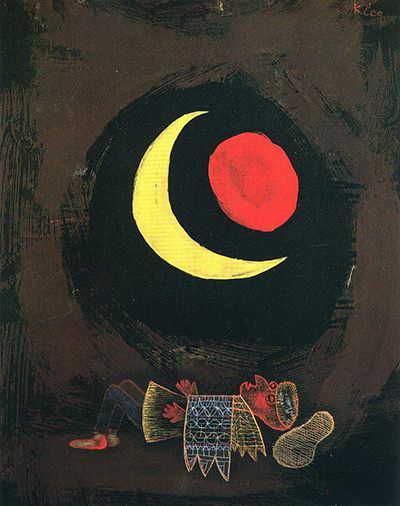
Paul Klee, “Strong Dream”, 1929
Bittersweet is a fascinating mixture of memoir, philosophy, psychology, and storytelling.
Upbeat music makes us want to dance around the kitchen and invite friends to dinner. Sad music makes us want to touch the sky.
Do you find listening to melancholy music healing? Here’s one of my favorites.
What’s on your sad song list?

 EVELYN KRIEGER
Favorite sad tune? So many summon melancholy—I’ll need to think about this! Love your post about Susan Cain’s Bittersweet! One of her other books – “Quiet” – was wonderful. I need to pick up Bittersweet. Thank you, Evelyn! 😊
LikeLiked by 1 person
I highly recommend it, Victoria. The book is very readable and relatable. I found myself underlining many passages. The story of her relationship with her mother and dealing with her death added depth to the book.
LikeLiked by 1 person
Thanks for that nugget – I’ve been following Susan Cain on LinkedIn and didn’t know there was a thread in Bittersweet about her mom…another reason for me to take a look. Sending hugs to you! 😉
LikeLike
Very interesting post! I love Leonard Cohen’s songs. They are profound, sad and uplifting at the same time and often with a touch of humor and self-irony. At the beginning of his career as poet/singer/songwriter, he and his band performed in several mental institutions in Canada and they realized how much the patients could relate to his songs and were touched by them. Thanks for sharing!
LikeLike
Thanks, Christa. Susan Cain writes about her obsession with Leonard Cohen’s music and the experience of seeing him in concert. One of my favorites is “Dance Me To The End of Love”.
LikeLiked by 2 people
Sounds like a fascinating book, Evelyn. I also enjoy listening to “Unchained Melody.” I don’t have a sad song list, but “Crazy” by Patsy Cline (1961) immediately came to mind.
LikeLiked by 1 person
Oh, Rosaliene, you brought back associations with Patsy Cline’s song. I do like that one. Susan Cain has a diverse listening list in the book and on her website. One of the classical pieces I never grow tired of hearing is Debussy’s “Reverie” and Ravel’s “Pavan for a Dead Princess”. Haunting.
LikeLiked by 1 person
Susan’s book sounds fantastic. I answered yes to all of the questions. Thanks for sharing, Evelyn!
LikeLike
Thanks, Jill. You are a kindred spirit! I’m sure you’d answer yes to the rest of the questions.
LikeLiked by 1 person
Very interesting Post! I tend to let music, movies or words move me. I feel it is a way of expressing my emotions and letting out the anxieties or negative feelings.
LikeLiked by 1 person
You have plenty of company, Roth. Your experience aligns with the research Susan Cain describes in her book. I’m with you on this!
LikeLiked by 1 person
Thank you. It is interesting how our emotions are expressed or repressed.
Dwight
LikeLike
I’m often drawn to sad songs, but I’m not sure that I find them to be healing. Maybe cathartic if I can cry. One I love is “Lost Without You” by Freya Ridings.
LikeLiked by 1 person
Perhaps the “healing” part is more comfort. Some people say they actually feel better after listening to sad music. I think this applies to those already feeling sad. I hadn’t heard “Lost Without You” but the lyrics definitely resonate. As Susan Cain points out, the source of much heartache is about separation from love.
LikeLiked by 1 person
This post is so interesting
The Italian sad song I love is Luigi Tenco’s “Lontano nel tempo”
LikeLike
Thank you, Luisa for sharing this song/singer. I just listened to Tenco. Very romantic and full of longing.
LikeLiked by 2 people
I am happy to know that you too found it very beautiful.🌹🌹🌹
Thanks a lot for your nice reply
LikeLike
I have a few. Clair de Lune by Debussy, Tears by Django Reinhardt and the Funeral March by Chopin. I’m sure I’ve forgotten some but there’s a few. A side note: melancholy for me isn’t necessarily a sad thing. I use it in my writing and suffer well 😊
I am a HSP (high sensitive person) and music moves me in all ways…
LikeLiked by 1 person
Clair de Lune always resonated with me as well, but just like Leonard Cohen, I considered it more thoughtful than melancholy. I wonder what that says about me? 🙂
The book sounds fascinating, and it has me thinking about more pieces of music that I considered thought-provoking, and now I’m thinking, perhaps they are sad? How about Pink Floyd’s “Time”?
LikeLike
The book is fascinating. I enjoyed her personal journey as well. In the back of the book she lists a variety of powerful music from different cultures.The lyrics to “Time” resonates with me more than the melody but I can feel some power there, too. Thanks for visiting!
LikeLiked by 1 person
We are kindred spirits, Poetpas. Love all those tunes. I also have a melancholy play list for certain creative writing. I think Susan Cain’s premise is what some call “sad” or “gloomy” is actually bittersweet at at the same time uplifiting. Thanks for reading!
LikeLiked by 1 person
Resonance, empathic connection, catharsis. Artistic existentialism is without doubt a common attribute of writers! Sounds like a worthwhile book. Thanks for featuring it.
LikeLike
Yes, indeed. The author also explores the artist/writer/poet/composer prevalence toward the bittersweet. Write on!
LikeLiked by 1 person
God Bless The Child , Forever Autumn, Somewhere Over The Rainbow , Any symphony by Beethoven , MacArthur Park
LikeLiked by 1 person
Great songs Usfam. Hadn’t heard of Forever Autumn but Autumn Leaves is in my list.
LikeLike
Forever Autumn – A Moody Blues favorite
LikeLiked by 1 person
I just listened to that one and realized I had heard it before. Great lyrics. Thanks for the reminder, Usfman.
LikeLike
Happy Holidays . My real name is Jim
LikeLike
Glad we’re on a first name basis. Wishing you an adventurous 2023!
LikeLiked by 1 person
Oh this book sounds like it’s well worth reading. I’ll add it to my list. Your post got me thinking about Rumi’s quote, “The wound is the place where the Light enters you.” Wonderful post. I’m very glad to have discovered your blog too Evelyn 🙏
LikeLiked by 1 person
Thank you, AP2 (What does your “name” mean?”) Interesting that you mention Rumi’s quote. Not only do I enjoy reading Rumi but the author of Bittersweet is obsessed with Leonard Cohen’s song that was inspired by this quote. I writing you
from O’Hare airport. Hoping for smooth sailing for both of us.
LikeLiked by 1 person
On the aeroplane I used to fly there were 2 autopilots. AP1 and AP2. Because I was a first officer I used to select AP2 whenever I flew. But it has a double meaning. Anxious Pilot because of my history with depression. I write under a pseudonym for political/professional reasons. Hope you had a smooth flight Evelyn. Thank you for your well wishes 🙏
LikeLiked by 1 person
Well, that depends on the sad song, to be honest- the way I am drawn to music is unique (not just limited to sad songs)
The sad songs I love usually belong to musical theatre and/or opera
LikeLike
I also love Broadway and some opera. I don’t mean to say that we are all drawn to sad music. I have playlists for upbeat, Happy. It depends on my mood and what I’m doing while listening. I think the author of the book was interested in why we might be drawn to sad songs? Do they make us feel more sad? Some people do not care for songs in the minor key. Thanks for visiting!
LikeLike
Haven’t made playlists based on emotion
For me, when it comes to Broadway, drawn to sad songs as a result of forming an emotional connection to characters- you care enough about them that you have that desire, reason, and want to go on their journeys and feel their emotions
I don’t think sad and/or heartbreaking songs make us feel more sad-why would we listen to them if they do?
LikeLiked by 1 person
Exactly. That is what The author discovered and more. I have different playlists for cleaning the house as opposed to dance or relaxation or writing. When I’m working on a novel I have specific songs to keep me in the scene.
LikeLike
I have been working on novels as well- one of which I actually finished. But, never once was able to think of a playlist for each of my WIPS
LikeLike
Congrats on finishing. Many never do.
LikeLike
Tale of the Cattail Forest- here is the summary blurb:
After moving to Fairy Creek, where the Fairy Frogs live, Sparkle explores her new surroundings to pursue her craft. As a drawer she is always looking for adventure and new places to draw. But when she ventures out beyond Fairy Creek into Graysloup, she encounters some toads and makes unlikely friendships and meets new challenges. The friendships all begin when she decides to befriend a young toad named Marge.
Things become challenging after encountering Sarge, leader of the toads, who tries to prevent all the friendships. Will the courage and cleverness of the Fairy Frogs stop Sarge from breaking up these new friendships? The frogs and toads learn how to use their talents and explore new ways of developing compassion and friendships
LikeLike
Fairy Frogs! Now that’s something different. Is this a children’s book?
LikeLike
Middle grade- so yes
LikeLike
I learned in music therapy that songs that match our current emotions help to validate what we are feeling, thus making us feel less alone and more understood. Hearing sad songs help us sometimes when we feel numb and have difficulty connecting with the emotions deep within us, or trapped in the traumas of our memories.
I attended a songwriting retreat this weekend, where us veterans were paired with a professional musician. We veterans mostly write the lyrics, whereas the professional musicians come up with the music and tend to perform the vocals as well. I wrote most of the lyrics, and I titled my song “Reunion.” I dedicated the song to veterans.
I just knew I needed to wait until after the music retreat to read your blog. It was strange how I just knew your blog would resonate with what I wrote and felt about music being a healing outlet, and one that helps me with mood modulation.
By the way, I love the song you shared in your blog post. It reminds me of the movie, “Ghost,” which is where I first heard it. I love all kinds of music from different eras and genres, but the ballads always inspire me for some reason – regardless if the ballads are sad or happy.
There is a thing called “toxic positivity,” where feelings aren’t validated. Sometimes music that is opposite of our emotions at the moment will trigger that “toxic positivity” feeling in us. One example of toxic positivity is when someone tells a grieving person or person dealing with trauma to “just get over it.” Or when people put time limits on how long we should grieve before just “letting go.” Grief isn’t measured the same for everyone, and everyone’s unique needs for validation, comfort, social connection, and even justice warrant those who can empathize. And sometimes when the world we live in is too chaotic to hug us when we need it, a simple sad song will. Songs can be compensatory relationships when human ones are nowhere to be found. I find that to be true at times.
And then there’s the off chance of meeting people who love the same songs for similar reasons, and therein lies a new connection. When I attend my music therapy groups, I find myself among those who get it. We may like different songs, but we describe the reasons behind liking those songs the same.
Susan Cain’s book sounds like a really interesting read, and one that will resonate with many! Thank you for sharing this with us, Evelyn!
LikeLiked by 1 person
Your thoughtful and eloquent response, G., has much to offer us all. Your description of how songs can make us feel “less alone, understood, validated, and connected” is also what Susan Cain’s personal experience and research has found. You can read more about Bittersweet Teachings and take the quiz at her website. (Link in post). She also has a wonderful newsletter called Kindred Spirits.
I love the idea of a sad son as a “hug”. I’m so happy to hear that you are involved in music therapy and songwriting. As I’ve said all along–you are a writer at heart! I look forward to hearing “Reunion”. Your chosen title resonates the song I linked to this post, “Unchained Melody”. It expresses the physical and emotional longing for someone is is far away and the need for reassurance that you are not forgotten.
LikeLiked by 1 person
Thank you, Evelyn! 🙂
LikeLike
It’s interesting because once Leonard Cohen was asked in an interview why so much of his music was dark and gloomy. He thought about it a moment and said he disagreed… he loves jokes as much as the next guy but the real definer of his work is honesty and truthfulness, as he saw it. He was all about depth. I live near Montreal, LC’s home city, and so there is mucho lore about him up here. 🙂
LikeLiked by 1 person
Thank you for sharing this. I wouldn’t call LC’s music “gloomy”, though perhaps there is some darkness. I’d go with Susan Cain’s description, “bittersweet”, which is aligns with honesty, truth, and depth.
LikeLiked by 1 person
Love this post.
LikeLike
Thanks, Saania. Which sad songs are on your playlist?
LikeLiked by 1 person
Oh definitely one of them is “the one that got away”
LikeLike