

Why does grief hurt so much?
Mary-Frances O’Connor’s new book, The Grieving Brain: The Surprising Science of How We Learn from Love and Loss attempts to answer this question and more through neuroscience and personal stories of bereavement.
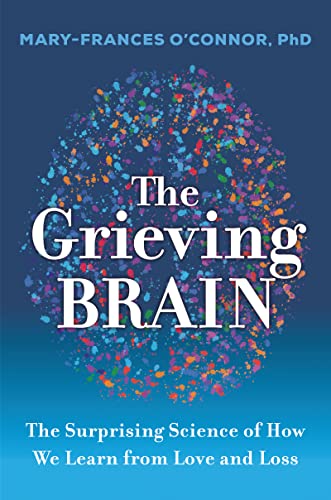
Dr. O’Connor, a clinical psychologist, directs the Grief, Loss, and Social Stress Lab at the University of Arizona. She studies the effects of grief on the brain and body. Her findings show how the brain’s hormones and neurochemicals produce this aching and seemingly unbearable sensation we know as grief.
Perhaps you’ve had the experience of disbelief after a loved one died.
Maybe you even continued to look for him or her, even though you witnessed the funeral. O’Connor explains this phenomenon.
The brain struggles to understand what happened when our loved one dies. The dimensions that we once knew them in—space and time—disappear.
Yet we remain attached.

Our brain hasn’t yet caught up with this disparity and still expects our loved one to return.
The brain has to unlearn the predicted associations of place and time. The passage of time is needed to update the mind maps we used to locate our loved one.

O’Connor’s grief studies include loss of important friendships and romantic breakups. These losses also produce a sense of disbelief and yearning.
Absence of a special person, O’Connor says, sets off emotional alarm bells. Our invisible attachment bonds are stretched beyond what we think we can handle.
This alarm is compounded if the absence occurs abruptly, a.k.a “ghosting”. Since our brain believes and knows the absent person is still “out there”, it searches for explanations and seeks to “fix” whatever led to the departure.
Just as after a death, our brain must learn to imagine a future apart from this absent love.
I found the The Grieving Brain a fascinating read. O’Connor sheds light on the universal experience of grieving, helping us to feel less alone, less crazy, and better equipped to move forward.
***
She concludes with this comforting thought:
“The physical makeup of our brain–the structure of our neurons–has been changed by them. …and these neural connections survive in physical form even after a loved one’s death…Once we have known love, we can bring it into our awareness, we can feel it emerge and emanate from us…Because of our bonded experience, that loved one and that loving are a part of us now, to call up and act on as we see fit in the present and the future.”
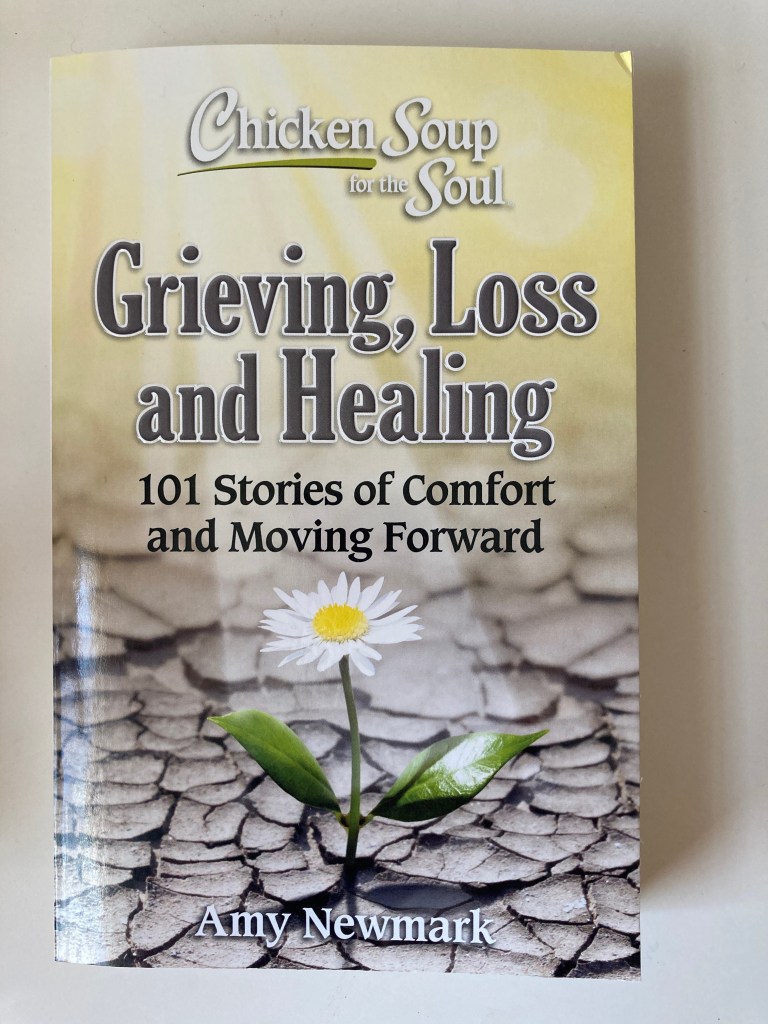
Update: My adapted essay, “Losing My Words”, has been included in the newly published Chicken Soup for the Soul: Grieving, Loss, and Healing. 101 Stories of Comfort and Moving Forward.

 EVELYN KRIEGER
Very thoughtful blog post, Evelyn! I’m sure that many people these days are struggling with grief and loss of many kinds, due to the pandemic and related adjacent issues. PS: I have to catch up on my blog post readings. I’ve been sort of incognito online, but I’m slowly returning to just a few platforms. I’m limiting my social media time these days, so I plan on responding better as I’m restructuring my days again. I hope you and your family are well!
LikeLike
I look forward to hearing your thoughts when you are ready. Limiting social media time is a good idea especially if you replace it with. something soul nourishing or even better, socializing in-person or a real phone call. I’m doing well along with my family. Thanks for asking.
LikeLiked by 2 people
I hope you and your family are doing well, Evelyn! I also hope to purchase more of your published works! You are an amazing person, author, writer, mentor, teacher, and friend!
I’m struggling with many forms of grief at the moment. Loss is stressful for most, traumatic for some. Loss is heterogeneous. People experience loss in many ways, such as the death of a loved one; the loss of a home burned in a wildfire, or torn down from a tornado; the loss of a career or job due to reputational losses and/or physical illness and/or mental illness; the loss of health, such as when people suffer from debilitating long-Covid or from complications with diabetes; the loss of relationships; the loss of consistency in life, such as when this pandemic brings so many unknowns to our future; the loss of financial stability; and so much more. I can imagine that the effects of such diversity of losses have similarities and differences. And, by extension, I can imagine that the grieving process for each of those losses might differ, too.
Then there’s the complexity of individuals and their lifestyles, cultures, and personalities. Those, too, factor in how we grieve.
When I used to read articles concerning foster kids, I came across this psychological variable called the “compensatory hypothesis” concerning “compensatory relationships.” Regarding the grief and loss issues that foster kids have, the scientists found that social support (an attempt to compensate for loss of previous relationships) didn’t fully compensate for the loss of biological parents (not including adopted children). However, social support did help to compensate for other relational losses – at least partially, if I can recall correctly. I’ll have to find that specific study and share that with you some time. What this tells me is that the type of relational loss matters in terms of moving on from grief, healing from grief, and the grieving process itself. Losing parents in a traumatic way or even as a result of childhood trauma is a form of loss that exacts extremely painful grief. I believe that is why some psychological scientists emphasize “traumatic grief and loss” (as opposed to just “grief and loss” – without the “trauma”) for such youth.
In a similar vein, I think the relationship with have with the loss will impact our grief process. The stronger the relationship, the stronger the loss, and thus the harder it is to overcome such grief.
One thing that has helped me to grieve, however, is to not look to “compensate” for losses. Instead, I try to respect my grief and the relationship that existed in the past. I give myself permission to reflect, cry, get angry, and feel all the emotions involved in grieving. On the other hand, I also try to see how new and different relationships can form in the future. What makes it challenging and scary for me, however, is fearing more loss in the future. Loss and the grief process that follows are painful!
I would be interested to see what the Chicken Soup Book says about grief and healing from it. I’m still struggling with grief (and related traumas, and then my own form of coping through dissociation – albeit maladaptive). I’m working with a great therapist who has been helping me for the past 3 years.
LikeLiked by 1 person
Thanks for sharing this book, Evelyn. I would definitely like to read it.
LikeLike
Glad you stopped by. I wouldn’t recommend it for someone fresh in grief but for anyone who is working through, has come out the other side, or is trying to understand or support another. The Chicken Soup Book is for all.
LikeLiked by 1 person